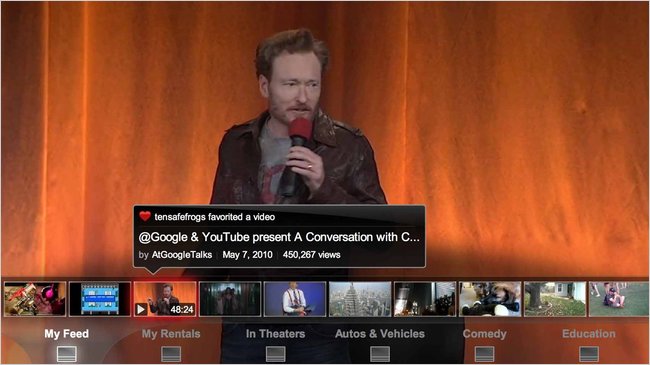
 I had thought that one big win for the internet, in terms of its social implications, was that it lets viewers be more active. Instead of sitting on the couch narcotized by the drug in front of you, you surf, make choices and actively explore. Internet utopians (and we’ve all drunk that kool-aid in one way or another) have touted this for years. It will change our consciousness, make us smarter, wiser. It will reduce the power of advertisers and networks and yes, even governments, to manipulate us and control what we think.
Well, now it seems that YouTube isn’t so happy with the active nature of internet video consumption. Why? Because it’s not so great for … advertising. What they really want is a passive audience: people that will sit still on the couch without leaving or changing a channel or clicking a mouse. They’re developing YouTube Leanback. (Yup — Orwell could not come up with names like this. They’re too good.) Quoted in a NY Times article Sunday, Jamie Davidson, a YouTube product manager, says, “We’re looking at how to push users into passive-consumption mode, a lean-back experience.” They want to limit “decision points” — moments between videos when you might click that mouse and go elsewhere. “There’s no browsing, no searching, no clicking.” said Hunter Walk, a YouTube program manager.
NowMov, a startup in San Francisco, offers a preview — popular YouTube videos streamed continuously. “If too much of your brain is occupied with the process of choosing, it takes you out of the experience of watching,” explains James Black, a NowMov co-founder. His goal is to free users from “the tyranny of choice.”
Yea, I guess that’s it. What’s wrong with the internet? Too much surfing.
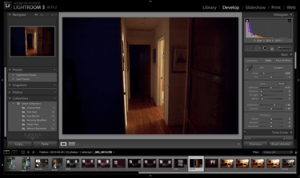 I had occasion to become familiar with Lightroom recently. A friend loaned me a Canon 5D and I wanted to look at the raw files I was making. Adobe is running a public beta for Lightroom 3 and I downloaded it. What a slick piece of work. The first time you use it, overlays appear above the interface explaining how it’s organized and giving you enough information to get started. Large buttons for basic functions point to Adobe’s confidence that they know what you want to do — and in my case they were right. And the program itself? Fast, stable, powerful — and beautiful. And still in beta. I was able to go through my images, rate them, color correct them and create a nice web site, without so much as cracking a manual.


 Splice Now
Recent Comments