Archive for the ‘Media and Society’ category

The Stealth Debates

August 20, 2007

What’s up with these presidential debates, anyway? The stealth debates, I should say, because it seems like nobody really wants us to see them. Did you know beforehand that there was a Democratic debate yesterday? It ran on ABC at 8 AM Pacific Time. George Stepanopoulis was the moderator and he worked overtime trying to make the candidates attack each other and focus on the kind of phony polarizing irrelevancies that TV news media seems to love so much. After the freshness of the questions on the You Tube/CNN debate it seemed even more irrelevant than ever.

Personally, I think there are some really hard problems we need to solve pronto. For example: extricating ourselves from Iraq without creating a blood bath, effectively dealing with global warming, and providing affordable health care for everybody. None of these things are going to be easy and these debates could be a good way to bring some of the difficult policy questions before the American people.

All the debates have been giving extra time to the three “front runners.” I put front runner in quotes because it just so happens that these are the folks with the big money and they’re going to be giving a lot of it to the networks. They’re ahead primarily because they’ve got good fund raising operations and thus, if you’re cynical, you might wonder whether they’re already bought and paid for.

We are well over a year away from election day. I want to hear from all the candidates. Biden, Dodd, Kucinich, Richardson and yes, even Gravel are the ones with the new ideas. They have less to lose and they sound a lot less scripted. Let’s hear from them. Maybe they’ll make the front runners work a little harder and talk a little more specifically.

The reason I bring this up is that there’s a media policy question at stake and it goes like this: The airwaves are a public resource. The networks license them and are supposed to use them not just to make a profit but for the public good. In the case of the HD spectrum the networks got all that extra bandwidth for free. We asked for nothing in return. Right now it seems like the absolute minimum we ought to get are debates that are widely publicized, that run at reasonable times of the day on broadcast television (not just cable), that give all candidates equal time, and that are archived on the web so anybody can see them at any time. It seems to me that, in a democracy, we should expect nothing less.

Technorati Tags:

The 700 MHz Auction — The Biggest Media Story You’ve Never Heard About

August 2, 2007

A decade ago, the US media landscape was transformed by the 1996 Telecommunications Act. This loosened the ownership requirements for big media corporations and ushered in today’s communications landscape dominated by a few huge players, disgruntled customers, and increasingly limited news sources. And it laid the groundwork for the transition to HD TV.

But, if you’re like most Americans, you’ve never heard about this law. Why? Because the corporations that you get your news from decided that you didn’t need to know about it. Or maybe because they thought it was too complicated for you. Either way, it was barely covered anywhere.

Flash forward to this week. The HD transition is almost complete. The networks were given a huge swath of spectrum to use for HD signals. This was estimated to be worth upwards of $50 billion in 1996, but it was given away free in exchange for the existing spectrum, the airwaves used to broadcast analog TV. Never mind that the HD spectrum can be used to show five channels while the old spectrum is good for just one.

The networks have been using the HD spectrum for several years, and now they have to return the old airwaves. The FCC will auction off this 700 Megahertz band to the highest bidder. And they will make rules for the auction, rules that will affect the ways we communicate for decades to come.

Add to this tasty stew the fact that the US cellphone system is far less flexible than what consumers are used to in Europe. Network neutrality — making sure that all broadcasters are treated equally — is common there. And in Europe phones and carriers are independent. The system works like your landline phone — buy your phone at Costco, plug it in and start talking.

Enter Google. Google has been talking about bidding for the 700 Mhz spectrum and they’ve advocated a set of auction rules designed to open up competition for broadband wireless services.

Meanwhile, a quarter of a million Americans have filed comments with the FCC, urging an open auction that will preserve competition and make sure that the spectrum doesn’t end up getting used in a closed, proprietary way.

Finally, enter the FCC. The five commissioners have more power over your media experience than just about anybody. But again, you probably couldn’t name even one of them. The Democrats, Jonathan Adelstein and Michael Copps, have generally been in favor of net neutrality and an open broadband system. The Republicans, Deborah Taylor Tate and Robert McDowell, usually come down on the side of corporate interests. The fifth and often deciding vote is the chairman, Republican Kevin Martin. Usually an industry guy, in the 700 MHz auction he’s supporting a compromise. The rules were decided on Tuesday, and details haven’t been made public, but they will apparently give Google some of what it wanted. Many consumer groups think that the FCC didn’t go far enough. The auction itself will start some time before the end of January.

For more on this subject check out SpectrumPolicy.org and SaveTheInternet.com.

For details about recent developments, check out these articles: Save The Internet, NY Times, Ars Technica #1, Ars Technica #2.

This may sound like arcane stuff, but how you will use the Internet and your cell phone for years to come depends on the lobbying of big corporations working behind the scenes with government. It behooves us all to learn about what’s going on and what the stakes are — even if the major media outlets don’t think we’re interested.

Technorati Tags:

McChesney and Reynolds on the Future of Journalism

May 9, 2007

This week, the L.A. Times is running a surprisingly thoughtful, five-part series on the future of journalism. It’s framed as a debate between Robert McChesney (one of the seminal thinkers in the media reform movement, founder of Free Press, author of many books, including the excellent, The Problem of the Media, and host of the radio show and podcast, Media Matters) and Glenn Reynolds (founder of the site Instapundit, and author of several books including “An Army of Davids,” released this year).

Both contributors believe that our sources of news are not serving us well, but McChesney focuses more on policy issues while Reynolds tends to be a free-marketer. The series makes for some very interesting reading and has implications for media as a whole, not just news.

A couple of quotes:

McChesney: “The crisis we face is that our smartest capitalists, not just the dumb ones, have determined it is not good business to do what our society needs in the way of journalism. The commercial news system has failed, and so far there is little indication that it is going to be resurrected in the digital world.”

Reynolds: “…traditional media organizations are still in a much better position overall to cover actual news than citizen journalists. They’ve got the infrastructure, the training, and the experience. But those advantages are eroding daily as technology shifts in favor of smaller operations, and as citizen journalists gain experience and audience.”

The series is available on the L.A. Times site. Part 1 is here. Links to the other segments are at the bottom of the page. The articles are also available at Free Press, linked from this page.

Technorati Tags:

Best News of the Week

March 24, 2007

Old TelephoneThe FCC decided Thursday that, for now, it won’t permit cellphones to be used on airplanes (NY Times, CNET). Hallelujah! Let’s declare a national holiday! I’ve been seriously wondering whether I’d be able to keep flying with everybody around me shouting into their phones. Apparently 8,300 people weighed in with letters to the FCC begging them to forbid this practice, but the decision, naturally, was made on technical grounds.

We humans are very skilled at directing our voices to the listener. We modulate volume with great precision and we unconsciously aim our voices at the person we’re addressing. But all that skill is lost when we talk into a cell phone. Even thought the listener’s ear is effectively just a inch or two away from our mouths, we generally speak quite loudly. Every time I see somebody doing this I think of people in the early part of this century cranking the little dynamo on their old phones and projecting into the mouthpiece. “Hello?! Hello?!”

In part, this phenomenon has to do with how your voice is played back into your own earpiece — something that early telephone engineers realized was essential to keep people from yelling and which they dubbed sidetone. Some cellphones apparently still don’t produce sidetone. The FCC ought to ban them immediately as a public health hazard.

Call me crazy, but In the meantime, I tend to walk up to the nearest shouter and, very politely, let them know that they are talking too loud. If you’re nice about it, this can work. Shouting is an involuntary reflex and, when made aware of it, some people will respond with embarrassment and make an adjustment.

Technorati Tags:

The Fear

March 23, 2007

I’ve been working as an editor for a long time now and I’ve always felt that the film business was more or less recession-proof. When the economy got bad people generally watched more movies and television. No matter what was happening to other businesses, Hollywood always did okay.

But today things don’t look so great. Below-the-line wages are down. In post production, this is partly because so many new people are entering the field. Editing has come out of the closet and has become, dare I say it, glamorous, to many people. This is a wonderful thing, but it brings with it increased competition, which inevitably puts downward pressure on wages. Even worse, there seems to be an across the board attempt on the part of many producers to lower below-the-line wages. And that’s hurting everybody.

But the real issue, the real monster in the closet, is the growth of the Internet as a video distribution medium. Nobody knows how this is going to shake out. The result is a pervasive sense of unease on the part of everybody in established media, from the lowliest messenger to the most powerful mogul, from newspapers to radio to television to film. What’s coming? What part of my business model is about to crumble? How do I prepare for it? And will I have a job when the dust settles? Nobody is immune.

This week we saw the release of the Apple TV, (reviewed in the NY Times by David Pogue), and yesterday NBC & News Corp. announced a big advertising-sponsored deal to distribute their content on the web.

We’re heading toward a world where you’ll be able to watch just about any video that was ever made and do so literally anywhere and any time you like. And that’s rocking our world in a way that’s never been felt before. It’s empowering a whole new group of filmmakers and entrepreneurs, and it’s scaring the bejesus out of everybody else.

Technorati Tags: ,

One Laptop Per Child

February 23, 2007

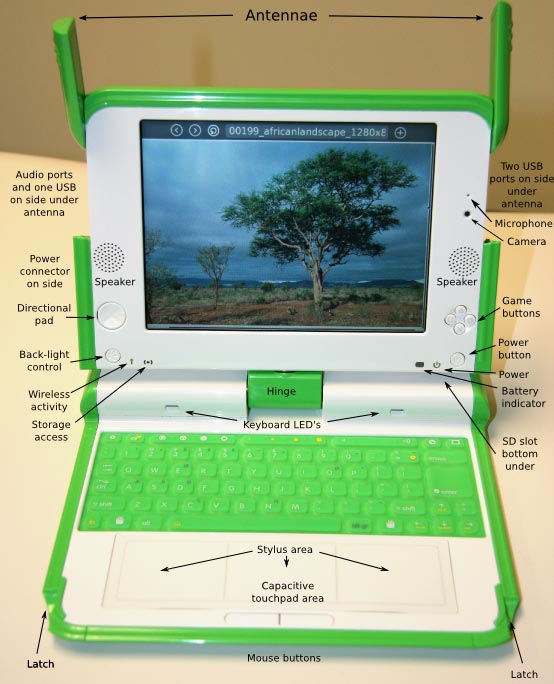
One-LaptopI’ve been listening to a fascinating episode of Chris Lydon’s terrific radio show “Open Source,” talking about the “One Laptop Per Child” project (OLPC). This was founded by the former head of MIT’s Media Lab, Nicholas Negroponte, and promises to provide a modern laptop to kids for about $150. The machine is unique in many ways. Chief among them: a reflective screen, so it works all day long on a single charge, open source, Linux-based software that can be updated by anyone, mesh networking, so individual machines work together to get on the net, camera, browser, email, VoIP, chat, word processing, spreadsheet and more, all built in. The plan is to sell them in lots of a million to developing nations. They are working on orders from several countries.

This is the next step in the democratization of computer technology — a path that we started on with the first mini-computers and which accelerated with the Apple II, the IBM PC and the Mac. It’s also the same path we’re on in post-production, as the “big iron” of the studios and facilities gets displaced by inexpensive desktop software.

This isn’t just about technology, of course, it’s about people. In Hollywood, the old world of post-production was very closed. Most of the people who got in had relatives who were already in. The ’60s and ’70s changed that, as 16mm equipment got into the hands of educators, film schools took off, and a series of court decisions opened up the IATSE.

But opening the doors can be awfully scary to the folks inside. Today, as editing equipment moves into high schools and post-production becomes sexier, we’re seeing the beginning of a new wave of young editors starting to knock on our doors. Is this a threat or an opportunity — or both? Does it hurt us, or bring new ideas?

Look at it this way: Microsoft, via Windows, owns the desktop, right? And for a long time, Microsoft represented the democratization of technology. The whole idea was to change society by putting a computer on every desk and thus shift power away from centralized mainframe computing.

But now, if this OLPC project takes off, a lot of kids in developing countries are going to learn about computers and the internet via Linux — with no Microsoft software in sight. Is that a long term threat to Microsoft? You bet it is.

Maybe this business of democratization is perpetual. And whoever is on the inside resists it, no matter how big they are. But if there’s any lesson in the past, it’s this: trying to keep new ideas and new people out is futile and self-destructive. Embracing the new is the only hope. The question for us, as editors, is not whether we do that, but how.

Technorati Tags: , , ,