Archive for the ‘Media and Society’ category

Spatial Interfaces

June 8, 2010

John Underkoffler is one of the great visionaries of UI design, and he’s just posted his talk about 3D spatial interfaces from the TED conference this year. This is the Minority Report UI (which he helped design) as it is being implemented — in reality — now. I had the great privilege of sitting in on his class at USC recently, where they were prototyping an editing application. My reaction at the time — it’s a slam dunk. The details don’t really matter. If we could have it, we’d use it. Take a look at his video (at TED or on YouTube) and start thinking about what computer interaction might be like sometime soon. And tell me that you don’t want it now.

Meanwhile, touch interfaces just got a lot more real for post-production with the release of iMovie for the HD iPhone. Apple has made it possible to shoot and edit on one small device and to do the whole thing via touch (and for a measly $5). It’s not for pros, of course, but it points the way.

MC5 will be released in a couple of days, and for the moment, things are pretty exciting in the world of non-linear editing. But these applications point to a different, more fundamental transformation — toward natural interfaces. Just when you thought things couldn’t get more interesting, the world shifts on its axis, and everything you know is wrong.
Irony for the Holiday

May 31, 2010

I had thought that one big win for the internet, in terms of its social implications, was that it lets viewers be more active. Instead of sitting on the couch narcotized by the drug in front of you, you surf, make choices and actively explore. Internet utopians (and we’ve all drunk that kool-aid in one way or another) have touted this for years. It will change our consciousness, make us smarter, wiser. It will reduce the power of advertisers and networks and yes, even governments, to manipulate us and control what we think.

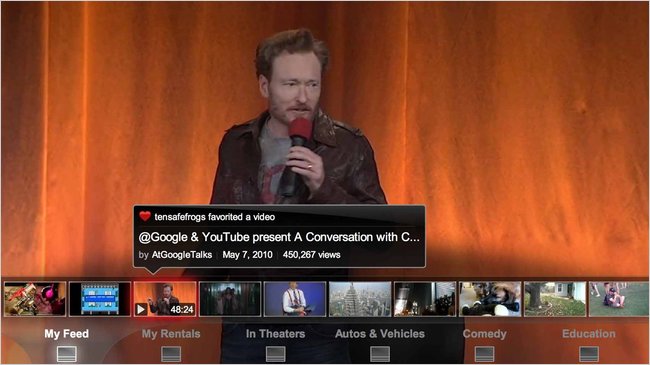
Well, now it seems that YouTube isn’t so happy with the active nature of internet video consumption. Why? Because it’s not so great for … advertising. What they really want is a passive audience: people that will sit still on the couch without leaving or changing a channel or clicking a mouse. They’re developing YouTube Leanback. (Yup — Orwell could not come up with names like this. They’re too good.) Quoted in a NY Times article Sunday, Jamie Davidson, a YouTube product manager, says, “We’re looking at how to push users into passive-consumption mode, a lean-back experience.” They want to limit “decision points” — moments between videos when you might click that mouse and go elsewhere. “There’s no browsing, no searching, no clicking.” said Hunter Walk, a YouTube program manager.

NowMov, a startup in San Francisco, offers a preview — popular YouTube videos streamed continuously. “If too much of your brain is occupied with the process of choosing, it takes you out of the experience of watching,” explains James Black, a NowMov co-founder. His goal is to free users from “the tyranny of choice.”

Yea, I guess that’s it. What’s wrong with the internet? Too much surfing.

Software as the Enemy

April 27, 2010

To add a bit of pointed levity to your day, the NY Times ran an article today about how some highly placed people in the military are coming to view Powerpoint as a big problem — not only a time-waster, but something that is actively dangerous. This isn’t the first time I’ve heard people complain about the program. But it’s the first time I’ve seen a piece of software described as something that can actively restrict thought and ideas — on the front page of a major newspaper. The fact that it comes from the military — from the reality-based community, to use a phrase popularized under Bush II — gives it even more weight.

A couple of choice quotes:

“PowerPoint makes us stupid.” Gen. James N. Mattis — Marine Corps Joint Forces commander

“It’s dangerous because it can create the illusion of understanding and the illusion of control” — Brig. Gen. H. R. McMaster

There’s more, and it’s pretty entertaining.
Check it out here: We Have Met the Enemy and He Is PowerPoint

Dede Allen

April 18, 2010

Dede Allen, one of the seminal figures in editing for nearly a half century, died Saturday of a stroke. She was the first editor I ever met, and she was partly responsible for my choice of career. I will miss her — her inspiration, her intelligence, her wisdom — more than I can say. The LA Times Obituary credits her with making editing an art coequal with cinematography. Whether that’s true or not, her influence has been pervasive.

Mia Goldman did a wonderful interview with her for the Editors Guild Magazine back in 2000 (when I was the magazine’s editor). She had just cut her first picture with an Avid, “The Wonder Boys,” after finishing a stint as an executive at Warner Bros. The interview is still online, and it shines a unique light on her point of view: Part 1, Part 2.

What We Leave Out

April 18, 2010

Michael Lewis, author of The Big Short: Inside the Doomsday Machine, a book about the financial meltdown that is getting rave reviews — not only for its substance, but for its writing — was interviewed recently by Christopher Lydon on his show, Radio Open Source. Lewis calls his kind of journalism “narrative nonfiction.” This is how he describes his process:

Writing is about, and this sounds strange, about leaving things out. The gift is to find — the luck is to find — the right things to leave out. And what’s the least you have to include to make it all work. It’s a process of accumulating lots of raw material, sitting in my office by myself, and figuring out how much I can get rid of.

What does that remind you of?

The interview — and it’s a good one — is here:

Our Appetite for Apocalypse. Also available as a podcast on iTunes

Local News — Not!

March 18, 2010

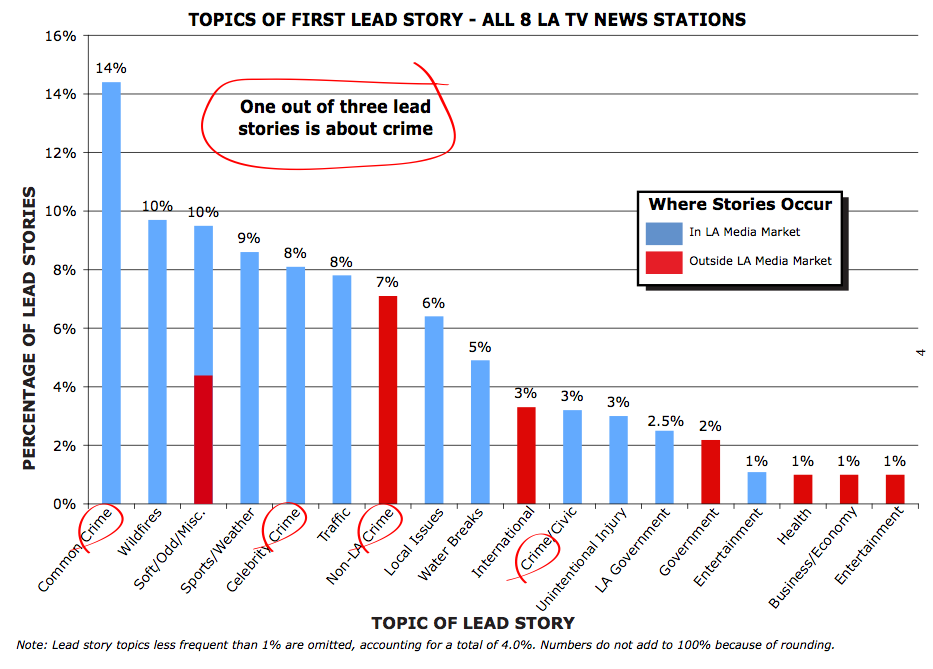
It probably won’t come as a surprise to you, but local news in Southern California is pretty much devoid of … well, news. Now, a recent study out of the Annenberg School of Communication at USC looks at 11,000 news stories and quantifies how devoid it is. Average nightly coverage of local government: 22 seconds in every 30 minutes. Yup. Twenty two seconds. Yet 68% of Americans say they get the majority of their news (whatever that is) from local TV.

Unlike the Internet, the airwaves are limited. Only a certain number of stations can broadcast, and they get licensed to do so by the federal government. That spectrum is worth big money, but the stations, once licensed, pay nothing. How hard is it to renew a license? You submit one postcard every eight years. Heck, it takes more effort to renew a driver’s license.

FCC Commissioner Michael Copps was interviewed on KPCC about this last week (listen to it here, or read his brief press release here). According to Copps, “twenty-seven states, over half of the states in this country, do not have an accredited reporter on Capitol Hill.” Wow. I’ve long been impressed by Copps. He’s a smart, unflappable public servant who does his homework and gets it.

Warren Olny interviewed Martin Kaplan, the co-author of the USC study, on his “Which Way LA?” radio show, yesterday. You can listen to the show here. (The interview begins at the half-way mark.) Olny offers some of the best local coverage around.

No citizen knowledge = no citizen involvement. And when nobody’s watching, mischief happens.