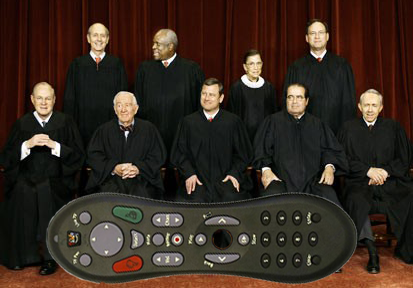
 Well, it’s finally happened–a US Supreme Court decision that affects the world of non-linear editing. Perhaps I exaggerate. But on Monday the court let stand a lower court ruling that allows cable TV operators to market network DVRs. The idea is that you’d simply identify the show you want recorded and the recording would take place on the cable company’s servers. No longer would you need a local hard drive to record or play back material–your existing cable box would do it all. This will inevitably make DVR technology cheaper and more widely deployed. Those of you who have “on-demand” service for selected programs know how convenient it is. This creates the possibility of on-demand service for everything and puts another nail in the coffin of scheduled television. Watch whatever you want, whenever you want, for less money with less hassle and no special equipment. Needless to say, the networks opposed the decision.
Archive for the ‘Media and Society’ category
The Supremes and the DVR
June 30, 2009We Like Being Interrupted
June 29, 2009I thought I had a pretty good idea of how commercials work, but an article in the NY Times surprised me. It seems that commercials can actually improve the way a show plays. People who watched an episode of “Taxi” with commercials liked it better than those who watched without interruption. If you like something, and it’s interrupted, you tend to like it more. That is, except when the show is demanding of your attention. So commercials make an escapist show that doesn’t require much attention play better. Who’d a thunk it?
The Digital Transition Arrives
June 15, 2009The networks finally turned off their analog over-the-air transmitters on Friday, after innumerable delays over a 13-year period. The FCC says that everything went well, but other reports indicated that they fielded 800,000 calls over the weekend, presumably from folks who weren’t prepared or weren’t getting a signal. That doesn’t sound like a smooth switch to me, but the only people who’ll tell you about it want you to think it went well. Very few people who work in government or media get their TV over the air anymore, so the subject tends to get short shrift in many circles.
Meanwhile we’re in the worst economic crisis since the great depression and lobbying interests still seem to control our government in the areas that most need change — banking, health care and energy. That’s because campaigns cost so much and most of the money comes from the business interests who fund those lobbyists.
How is this connected to digital TV? The networks got five times the bandwidth from the FCC for no charge. They could have thrown in some free airtime for campaign ads, but of course that would have cut into their bottom lines. Congress could have insisted on a better deal, but the subject was barely debated.
“Innovation in Hollywood”
February 16, 2009Author Scott Kirsner will host a panel discussion on new technologies and how they’ve been adopted in cinema, from Thomas Edison to the present. It’ll take place this Thursday, Feb 18, at 5 pm at the Annenberg Auditorium at USC. Scott has written two valuable books on digital cinema and he’s now responsible for two blogs: CinemaTech and Innovation Economy.
Details are here: Innovation in Hollywood: Past, Present & Future
Mark Your Calendars
December 22, 2008Well, the much-heralded digital transition is upon us. The switch to over-the-air HD transmission happens Feb 17, and despite hundreds of millions of dollars taxpayer money spent on “education,” there are still many questions in the minds of Americans about what it means to them.
(Spot quiz: If you get your cable TV with an analog set and without a cable box, are you going to need a converter? Extra credit: If you get a converter box are you going to see your TV letterboxed or center-extracted?)
The NY Times ran a summary article today referencing surveys that point to fundamental misconceptions in the minds of roughly 40% of our population. The digital transition was one of the biggest giveaways to business ever (prior to the Wall Street bailout, that is) and, so far, has produced nothing in the way of public service. And we continue to spend money on it, as the Times describes.
Technorati Tags: media and society
Earbuds and Your Hearing
December 10, 2008Not to focus too much on health issues, but the NY Times ran a cautionary piece by Jane Brody on Tuesday (All That Noise Is Damaging Children’s Hearing) that bears reading for anybody who relies on their ears for their livelihood. Turns out that there’s an epidemic brewing in hearing loss among kids who are spending more and more time with ipods and other devices that pipe sound directly into the ear.
Tinnitus (persistent ringing in the ear) and hearing loss are incurable. Once you’ve got it, you’ve got it for life, and it only gets worse with time.
I listen to an ipod a lot. But lately, I’ve been turning it down as much as possible and finding that I can hear just fine at lower volume levels.
We’re all involved in a giant beta test of these and other new devices. Buyer beware.
Technorati Tags: media and society



 Splice Now

Recent Comments