Archive for the ‘Workflow’ category

Open Standards

March 1, 2007

I just finished reading an article in the Editors Guild Magazine about the making of “Zodiac.” It’s pretty hard to figure out exactly what they did, but the general outlines are there and they reinforce a lot of what I’ve been saying in recent posts, namely that file-based workflows are coming at us very quickly.

The show was shot with the Viper FilmStream camera and used Final Cut Pro in the editing room. The editors were responsible for archiving and cataloging the original camera source files, for down-converting those files to DVCPRO HD for editing, and, apparently, for conforming the show back to 2K for the DI. They also did some color correction using FinalTouch. In other words, the cutting room took on a lot more responsibility than is traditional. That’s good news for assistants because there was certainly plenty of work for them, but if this workflow takes hold it also means that assistants and editors have a lot of learning to do.

If everything’s going to end up as files, then much of the work on a show will turn on how we handle, store and move these things, and, most important, how they translate from one program to another. And here, I worry about Avid. The company has stuck with closed standards for a long time now. That made sense in the old days when people wanted something that was totally supported and really worked. We still want that today, of course, but more and more, we want to be able to pick the best software for the job and move materials back and forth transparently.

In that environment, Avid’s closed approach looks more and more anachronistic. Avid bins can’t be opened by other programs, Avid visual effects don’t translate into anything except Avid products, Quicktime export and import is slow and confusing, and even Avid sound files can be hard to share with all data intact.

On the other hand, the Media Composer still has many advantages, and Avid tends to understand our work very well. This stuff is still new, and there are plenty of hiccups on both sides of the aisle. But it’s easy to see that the company that gets this right is going to have a big advantage.

Technorati Tags: , , , ,

One Laptop Per Child

February 23, 2007

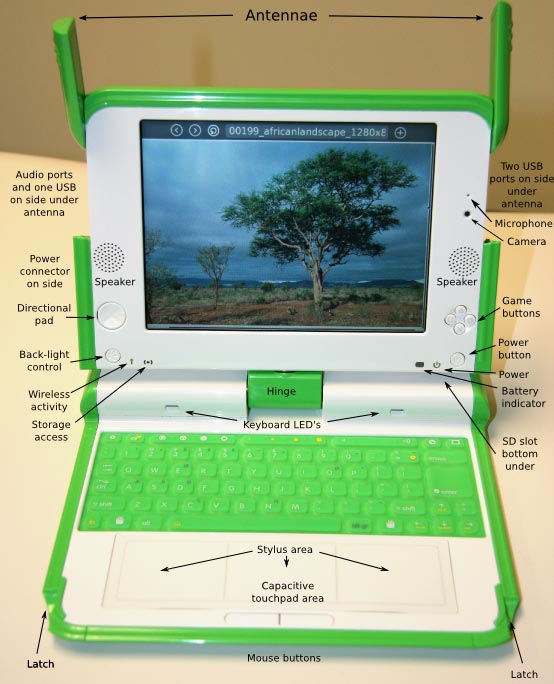
One-LaptopI’ve been listening to a fascinating episode of Chris Lydon’s terrific radio show “Open Source,” talking about the “One Laptop Per Child” project (OLPC). This was founded by the former head of MIT’s Media Lab, Nicholas Negroponte, and promises to provide a modern laptop to kids for about $150. The machine is unique in many ways. Chief among them: a reflective screen, so it works all day long on a single charge, open source, Linux-based software that can be updated by anyone, mesh networking, so individual machines work together to get on the net, camera, browser, email, VoIP, chat, word processing, spreadsheet and more, all built in. The plan is to sell them in lots of a million to developing nations. They are working on orders from several countries.

This is the next step in the democratization of computer technology — a path that we started on with the first mini-computers and which accelerated with the Apple II, the IBM PC and the Mac. It’s also the same path we’re on in post-production, as the “big iron” of the studios and facilities gets displaced by inexpensive desktop software.

This isn’t just about technology, of course, it’s about people. In Hollywood, the old world of post-production was very closed. Most of the people who got in had relatives who were already in. The ’60s and ’70s changed that, as 16mm equipment got into the hands of educators, film schools took off, and a series of court decisions opened up the IATSE.

But opening the doors can be awfully scary to the folks inside. Today, as editing equipment moves into high schools and post-production becomes sexier, we’re seeing the beginning of a new wave of young editors starting to knock on our doors. Is this a threat or an opportunity — or both? Does it hurt us, or bring new ideas?

Look at it this way: Microsoft, via Windows, owns the desktop, right? And for a long time, Microsoft represented the democratization of technology. The whole idea was to change society by putting a computer on every desk and thus shift power away from centralized mainframe computing.

But now, if this OLPC project takes off, a lot of kids in developing countries are going to learn about computers and the internet via Linux — with no Microsoft software in sight. Is that a long term threat to Microsoft? You bet it is.

Maybe this business of democratization is perpetual. And whoever is on the inside resists it, no matter how big they are. But if there’s any lesson in the past, it’s this: trying to keep new ideas and new people out is futile and self-destructive. Embracing the new is the only hope. The question for us, as editors, is not whether we do that, but how.

Technorati Tags: , , ,

The Wave Returns

February 22, 2007

Post-production was the first Hollywood craft to face the digital revolution. It felt crazy and chaotic at the time, but in hindsight, we did pretty well with it. Just about everybody was able to make the jump to lightspeed, as it were. We worked hard to learn the new tools and, as a result, we were able to continue to do the work we love.

That first big wave of change has now spread out into the rest of the production chain and, today, camera seems to be going through a process similar to what we experienced a decade ago.

The wave has also moved out into the society at large. Not only does every teenager have access to post-production tools that are more sophisticated than what we had access to just a few years ago, but every couch potato can record shows with a DVR that would put our old Avids to shame. And everybody with a bit of internet savvy can get their short videos distributed free via YouTube.

In short, all audiovisual media is becoming digital and everybody can control it in unprecedented ways. Which means the changes have just begun — again.

We’ve been looking one way, at the tools, but the wave is coming from a different direction now, from the society at large. These are some of the issues:

  • The first digital editing rooms were based on monolithic software/hardware combinations that did everything you needed. More and more, today’s cutting rooms rely on a wider range of inexpensive, software-only applications.
  • In the past, entry into our field was limited via an apprenticeship program. Today, the barriers to entrance are much lower. You can learn a great deal not just in college, but in high school.
  • Editing used to mean lots of heavy gear. Now you can set up an adequate cutting room in your spare bedroom.
  • Getting film from one place to another used to mean driving or flying it there. Now it means moving it around on the internet.

How is all this going to affect us? What do we do to prepare for it? How do we shape these forces so they work for us? As I said at the Eddie awards, we have to put our heads together, come up with a picture of the post-production landscape of the future, and start thinking about solutions. And we have to put renewed emphasis on education, not just about the tools, but about that dreaded subject, workflow.

This 2nd wave is coming. When it hits, we need to be prepared.

Technorati Tags: , ,

The Robert Wise Award

February 19, 2007

Robert Wise AwardLast night I received the Robert Wise Award for “Journalistic Illumination of the Art of Editing,” at the American Cinema Editors’ 57th annual Eddie Awards banquet. It was a wonderful night for me, the culmination of nearly 20 years of work in this community. This morning, I’m still basking in the glow of the support I felt from so many friends and colleagues.

ACE president Alan Heim presented me with the award and mentioned this site, so I expect that at least of few of you will be here today for the first time. Welcome!

I encourage you to browse around and get a sense of what’s here. The content is bit more perennial than on some blogs. There are Avid tips, discussions of Avid problems, talk about the changing world of editing, and notes about the growing influence of media in society. Your way into this material is through the links in the right hand column: “top posts,” “recent posts” and “categories.” If you want to read it all you can do that via the archives.

I hope you’ll add your ideas via the comment links at the end of each post. A blog is a conversation, and I’m eager to hear your thoughts.

My acceptance speech took off from some of the recent postings here. The editing revolution of the ’90s was about tools. We saw our Moviolas and KEMs replaced with computers and hard drives. Things seem to have settled down in the last few years, but my contention is that there’s another revolution brewing, one that is stealthier because a lot of it is taking place outside our editing rooms, but in the long run, no less disruptive. That’s the workflow revolution, the many changes that together will soon result in all the materials of our work, from camera to screen, turning into zeros and ones. The effects of that transformation: inexpensive, desktop software, internet based post-production, portable editing rooms and increasing competition, are going to rock our world just as much or more than the first phase did.

We did a lot of things right in the 1990s. In particular, we focused on two things: education and community support. Today, I think we need to take another hard look at the changes around us and push our educational programs aggressively to cover these new issues. I know we can handle it. Our strength as a community served us so well in the first phase, and we’re wiser now, but we’ve gotta get moving.

Technorati Tags: , ,

Does Stability in the Media Composer Mean Complacency for Editors?

February 8, 2007

The basic Media Composer feature set and user interface haven’t changed much in a decade. Sure some important features have been added, but for a lot of people in features and TV, the big learning curve was over a long time ago.

This has given the community a chance to refocus on what we love best, namely editing. But I think it’s also creating a false sense of security. The emphasis on education, so strong in the mid-90s has waned. Many editors I know even resist learning new things about the Media Composer itself.

Meanwhile, post-production continues to be fundamentally transformed. We’re seeing a shift to desktop applications, file-based workflows and distributed work environments. Editors are responsible for larger and larger swaths of the post-production landscape. And we’re facing stiffer competition from all over the world.

Are feature and TV editors prepared for this new world? I hope so. But one thing is certain — the stability of the Media Composer user interface should not be taken as a sign that things have stopped changing.

Technorati Tags: , , , ,

City Traffic and Remote Collaboration

February 6, 2007

I’ve been following Steve Lopez’ LA Times columns and his blog about LA traffic. The more I drive in this city the more I want to stop doing so.

LA recently “improved” an intersection in my neighborhood, adding a left turn lane and re-timing the light. The result, at a cost of tens of thousands of dollars, has all but ruined the intersection, increasing wait times for everybody and causing a blocks-long backup during rush hour. With improvements like this, the city will be gridlocked in no time. The “cure” is killing the patient.

But this summer I bicycled to work — and I’ve never had a happier commute. I arrived every day feeling invigorated and every night looked forward to the trip home.

In LA, where bike lanes are few and distances are long, the luxury of being able to do this is rare. And that makes me think our salvation will be in “remote collaboration.”

The relative simplicity of our new editing equipment, the shift to file-based workflows and the growing availability of fast internet connections, are making it possible to do all kinds of things from home. This is going to get even more appealing once AT&T and Verizon get their fast new fiber networks installed.

But there are disadvantages, too. Here are some of the pros and cons as I see them:

The Good

  • Working at home means functioning in a congenial, comfortable environment.
  • Skipping the commute means you’re fresher all day long. You experience less stress and less exposure to highway smog.
  • You can work more flexible hours, so it’s easier to deal with kids and family.
  • You’re more productive because you’re not wasting precious hours in traffic.
  • Staying out of your car means you’re reducing your “carbon footprint” and doing your part for global warming.

The Bad

  • Figuring out how to work at home and getting producers comfortable with the idea means that we’re making it easier for people all over the world to do exactly the same thing — and thus compete with us from afar.
  • Working at home means that there’s no social interaction at work.
  • You’re probably going to own at least some of your own equipment and you’re going to have to do more of your own tech support.
  • When you’re working from home, employers tend to think you’re available 24/7. You’re more likely to work extra hours and not charge for it.
  • Work rules like meal penalty and turnaround are harder to enforce.
  • Work and life tend to get intermixed. You can’t go home at the end of the day — you’re already there.

Whether we like it or not, this new internet-enabled, portable workplace of the future is coming at us. Are we prepared for it technically? Institutionally? Contractually? My feeling is that we need to get ahead of this trend and start figuring out how it’s going to affect us — now while we can still exercise a little control.

Technorati Tags: , , , ,