New IATSE Contract (revised)

Posted January 17, 2009 by Steve
Categories: Editors Guild

The Editors Guild will be holding an open meeting Thursday to explain the new IATSE basic agreement, on which members will be voting shortly. The most controversial provision is an increase in the basic health plan eligibility requirement from 300 to 400 hours — in the third year of the contract. This will make it harder for people who don’t work much to get coverage.

It also means that it’ll be harder to fill up your bank of hours. For those of you who don’t understand it, the bank extends your health insurance coverage. You accumulate hours in the bank during good times and then cash those hours in for another six months of coverage when your ordinary hours run out. It used to take 300 hours to get another half year of coverage, now it’ll take 400. Also, the maximum amount you can hold in the bank — 450 hours — won’t change, so you’ll get less out of the bank during a long dry spell.

Needless to say, this comes at a very bad economic time. I know many people who have been facing long unemployment periods and are turning to self-pay via COBRA to keep their benefits. But that can be startlingly expensive.

Details of the contract leaked out long ago and can be reviewed here. There’s also a new web site devoted to challenging the 400-hour requirement here.

The Guild recently sent out an email describing the contract in general terms, and it promises to get members the complete memorandum soon. I hope that it comes in time for us to read it before Thursday.

Meeting details:

Thursday, Jan. 22nd
Directors Guild
7920 Sunset
Los Angeles
7:30 pm

A similar meeting will take place Tuesday, February 10 at the New York office.
Mark Your Calendars

Posted December 22, 2008 by Steve
Categories: Media and Society

Well, the much-heralded digital transition is upon us. The switch to over-the-air HD transmission happens Feb 17, and despite hundreds of millions of dollars taxpayer money spent on “education,” there are still many questions in the minds of Americans about what it means to them.

(Spot quiz: If you get your cable TV with an analog set and without a cable box, are you going to need a converter? Extra credit: If you get a converter box are you going to see your TV letterboxed or center-extracted?)

The NY Times ran a summary article today referencing surveys that point to fundamental misconceptions in the minds of roughly 40% of our population. The digital transition was one of the biggest giveaways to business ever (prior to the Wall Street bailout, that is) and, so far, has produced nothing in the way of public service. And we continue to spend money on it, as the Times describes.

Technorati Tags:

Media Composer 3.1

Posted December 11, 2008 by Steve
Categories: Avid

Avid released Media Composer v3.1 on Tuesday. The release mainly offers support for Video Satellite in Pro Tools 8, which allows MC and PT systems to be locked together over an ethernet connection and to play in sync, with either one acting as a master. It’s a very cool idea and if you’re running a mixing stage it may mean a lot to you.

For the rest of us there are quite a few bug fixes, which are detailed in the readme, and which you can find here. If you’d rather not download the pdf and wade through it, Larry Jordan has helpfully reposted the “changed in 3.1” and “fixed in 3.1” sections on his site, HDFilm Tools. Several of the bug fixes have to do with FilmScribe and EDL Manager.

Technorati Tags: , , ,

Earbuds and Your Hearing

Posted December 10, 2008 by Steve
Categories: Media and Society, Quality of Life

Not to focus too much on health issues, but the NY Times ran a cautionary piece by Jane Brody on Tuesday (All That Noise Is Damaging Children’s Hearing) that bears reading for anybody who relies on their ears for their livelihood. Turns out that there’s an epidemic brewing in hearing loss among kids who are spending more and more time with ipods and other devices that pipe sound directly into the ear.

Tinnitus (persistent ringing in the ear) and hearing loss are incurable. Once you’ve got it, you’ve got it for life, and it only gets worse with time.

I listen to an ipod a lot. But lately, I’ve been turning it down as much as possible and finding that I can hear just fine at lower volume levels.

We’re all involved in a giant beta test of these and other new devices. Buyer beware.

Technorati Tags:

Media and Health

Posted December 7, 2008 by Steve
Categories: Media and Society

Would you be surprised to learn that increased media exposure is associated with higher rates of obesity, smoking, sexual activity, drug and alcohol use among young people?

A recent report from the National Institutes of Health analyzed 173 previous studies in a first-of-its-kind analysis. A New York Times article summarized the report this way:

In a clear majority of those studies more time with television, films, video games, magazines, music and the Internet was linked to rises in childhood obesity, tobacco use and sexual behavior. A majority also showed strong correlations — what the researchers deemed “statistically significant associations” — with drug and alcohol use and low academic achievement.

The evidence was somewhat less indicative of a relationship between media exposure and attention-deficit hyperactivity disorder, the seventh health outcome that was studied.

The report quoted one of the lead researchers as follows: “The average parent doesn’t understand that if you plop your kids down in front of the TV or the computer for five hours a day, it can change their brain development, it can make them fat, and it can lead them to get involved in risky sexual activity at a young age.”

Technorati Tags:

Early Avid Videos

Posted November 29, 2008 by Steve
Categories: Avid, User Interface

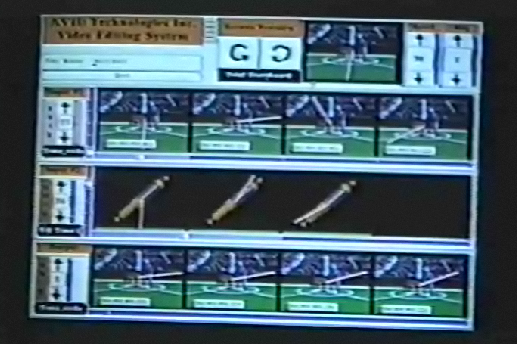
avid-prototype-2Bill Warner, Avid’s founder, has posted some fascinating early videos, from as far back as 1987, on the Viddler site. Several cover the earliest Avid prototype, a system that simply played a few clips and could assemble them together. Everything ran out of RAM — on an Apollo minicomputer. They had no way to digitize anything, so for testing they created short clips out of stills with a superimposed moving line to let you know something was changing.

It’s a real and raw look at the genesis of a system and metaphor that we all take for granted now. This early version didn’t have a source or record monitor or much of a timeline. But in Bill’s comments you already hear the idea of three-point editing and the distinction between an insert and an overwrite. In a strange twist, the prototype bears a certain conceptual resemblance to iMovie ’08.

For those of you who were part of the revolution back then there’s also a video featuring “The Visitor,” which we all used as practice material. A segment from a local news show and an early Avid promotional video are also included.

The videos are here. They’re in reverse chronological order — the oldest is last in the list.

Technorati Tags: , ,