Archive for September 2008

Media Composer 3.0.5 / Select Right

September 30, 2008

Media Composer version 3.0.5 was released this week and, along with some key bug fixes, it offers a couple of important new features.

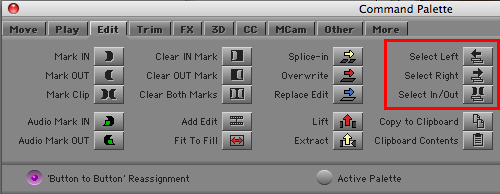
First and foremost, it allows you to select all clips to the right or left of the blue cursor, or all clips between marks. This makes it trivially easy to open up space in the middle of a complex, overlapped timeline. Just select all tracks, hit the new “select right” button and drag everything to the right. Voila, you’ve got a nice empty space in your timeline, without cutting up any clips or doing any cleanup work. Final Cut has had a similar feature for a long time, but it’s a valuable and nicely implemented addition to the MC.

Select Right makes it easy to go from this:
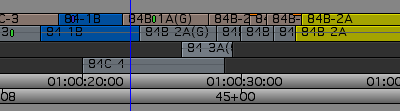
to this:
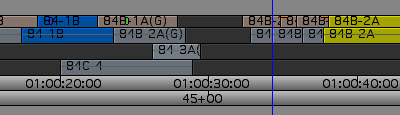
You’ll find buttons for these new features in the Edit tab of the command palette.
Second, you can now generate a report with lots of useful information about a particular sequence or source clip. You’ll find this in the “Get Clip Info” or “Get Sequence Info” windows, which have been expanded. For sequences, you can list all your effects or sources, among other things.
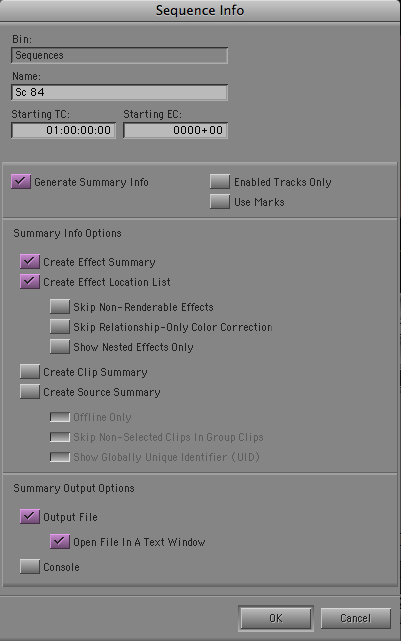
You access these reports by clicking in the source or record window and selecting “Get Sequence Info” or “Get Clip Info” from the File menu. You can also use the contextual menu — on the Mac, hold down shift and control and click on the source or record window.

Other changes in this release include a very important fix to the Save All command so that Autosave doesn’t waste time saving unchanged bins (hallelujah!), and a fix to the burn-in tool so it doesn’t crash over black segments when showing source info. There’s also a fix to trim mode so that when trimming two head or tail frames (a new feature in version 3) you’ll hear correct scrub audio. There’s a helpful fix to segment drag sync locks (in timeline settings), and a fix to the locator window so you don’t have to see it every time you create a locator.

All in all, this is a very useful release. Avid says it has only been qualified for OS X 10.5.4. I installed it on 10.5.5 and it seems okay so far.

If you’re using Media Composer software-only and you’ve already got version 3, you can download the update here. As usual, you must uninstall first. Avid really ought to fix that. The system should check for updates and do whatever uninstalling is needed automatically.


Technorati Tags: , , ,

The Virtualization of Money

September 24, 2008

I’ve become a news junkie over the last few weeks, and reading the financial pages, I’m starting to wonder whether it isn’t the computers themselves that have done us in. In post production, we’ve seen how the digitization of physical materials has transformed our world. The process of virtualization, of turning real things into their digital analogs, which so disrupted our lives fifteen years ago, has now insinuated itself across the culture, and most significantly, into Wall Street.

When people loaned money fifty years ago, they did it against collateral that you could touch and feel. But today, most loans are made on derivatives — complex virtual “instruments,” composed of tiny pieces of myriad other loans, made possible only in an age of ubiquitous high-speed computing. They were traded and re-traded, sliced and diced and hedged with even more complex and arcane products, with huge sums moving in “flows” and with traders handling nothing more real than a computer keyboard.

Which is all fine and good as long as nobody starts to ask the “elephant in the room” question: What’s it all worth?

It seems like traders and investors are now collectively starting to wonder whether they have sliced and diced these instruments so finely, and traded them in such complex ways, that they are really funny money — nothing more than worthless bits and bytes, suspended in the digital river only by the confidence of investors who, it seems, don’t really understand them at all.

The Fed now wants to get rid of these things by simply buying them up en masse. It’s a nice trick. Create products that the computer tells you are real. (Don’t question that computer!) And when it turns out that they represent nothing at all, get rid of them, make them disappear. There’s only one small catch. To replace the virtual thing with the real thing you need the real thing — in this case, money. And somebody has to provide it.

Technorati Tags:

Another Word You Can’t Say on TV

September 22, 2008

Forgive me if I’m going too far afield here, but watching the Sunday morning talk shows yesterday I was struck by the fact that nobody wants to talk about the “catastrophic” consequences that will befall us if we don’t go into hock for another $700 billion or so (about $2500 per U.S. man, woman and child).

On “This Week,” George Stephanopoulos asked Hank Paulson about what those dire consequences would be. Paulson gave the vaguest answer imaginable. When Stephanopoulos later pushed Chris Dodd and John Boehner about it, both demurred with enough significant looks back and forth that it almost seemed like a bad soap opera. Apparently, they can’t tell us what we should be afraid of because “the language has an impact.” Boehner actually said, “you can’t describe, on Sunday morning, how ugly this picture would look, if we don’t act.” Stephanopoulos’ reply, “why not?,” didn’t get much of an answer. (Video is here. The part I’m referring to is about five minutes in.)

I assume that the word they don’t want to utter is “depression.”

I’ve heard of the “F word,” the “B word” and the “N word.” But the “D word?” How delicate are we? If you want me to borrow that much money, you ought to be straight with me about what’s going to happen if I don’t do so.

Technorati Tags:

Teleprompter Blues

September 5, 2008

What fascinated me about all the convention speeches in the last few days is the Harry Houdini part — the teleprompter. There were three, of course, surrounding the podium. Each speaker turned methodically from one to the other. Center – right – center – left – center – right, etc. Once you figured out what was going on, it was almost comic.

What’s wrong with these things is that they hold less than a sentence of text. So it’s impossible to get up a good head of steam when you are speaking. If you’re not a great public speaker you inevitably get into a sing-song rhythm, reading off a line or two as it appears before you and waiting for the next one. Carly Fiorina was a classic example. Utterly monotonous delivery, the same rhythm for every sentence. Most of the minor speakers, Republican or Democratic, fell into this trap. Combined with the fact that many of the speeches sounded suspiciously like they were written by the same person, the result was nothing if not B O R I N G.

Using a teleprompter well is obviously a skill — you want to look like you’re speaking off the cuff, and the machine almost completely prevents that. In a way, it’s akin to Powerpoint, which some have blamed as a bane on American business. If you use these pieces of technology the result is competence — but zero personality, zero energy. It’s all about sticking to the script.

I’m also struck by the implicit collusion between the networks and the conventions in carefully hiding the teleprompters. This takes work and preparation. Shots have to be designed to conceal these things — heck they’re right in the speaker’s eye lines and have to be. But the networks want to conceal them as bad as the candidates do. The more I think about that, the more it worries me.

Think what the convention would be like if you saw the teleprompter in every shot. What would happen if you were conscious, throughout every speech, that the speaker was reading, line by line? I was at an awards ceremony recently where the teleprompter was quite visible to the live audience, and every time I looked at it, it totally changed my sense of the event.

The illusion is that the person talking is speaking extemporaneously. The reality is that they are just reading a script. Once you grok that the whole thing changes. But nobody wants you to see it. Not the speaker and not the media. Is that reporting?

Technorati Tags:

Inventing the Movies

September 1, 2008

My friend Scott Kirsner has a new book on the history of filmmaking technology that readers here might find interesting. It’s called “Inventing the Movies” and, in part, covers Hollywood’s historical resistance to new technology. I have it on good authority that I am quoted in the book, so of course I want you all to rush out and buy it. The book’s website is here, and it’s available via Amazon at this link. Scott was recently interviewed on NPR’s “Science Friday.” You can listen at this link via iTunes.

Scott has posted a selection of entertaining and not-so-prescient quotes from Hollywood notables. It starts with Thomas Edison’s comment that ten projectors would be enough to serve the whole country and George Eastman’s idea that the public will never accept film sound. As the screenwriter William Goldman has famously said, “Nobody knows anything.”