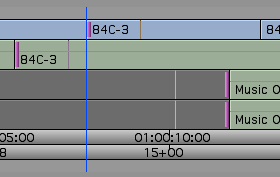
 I had an interesting debate with a music editor friend the other day. Frustrated (as we all are) with the hoops you have to jump through to move material back and forth between Media Composer and Pro Tools, he suggested that MC simply start using Pro Tools as its audio engine. And not just the engine — the whole UI. MC just synchronizes with PT. End of story.
I completely agree with the need to move sequences/sessions and media back and forth without conversion. But much as I envy the Pro Tools toolset (as I describe in this post), I don’t want to rely on the PT interface. Why? Because I’d have to give up Trim Mode.
My friend wouldn’t have it. “I can do anything you can do,” he insisted. I tried to explain that he can’t trim while watching picture or listening to sound. He said he didn’t need that — he just drags things around and hits play to check the work. Or he trims using PT’s trim tool. No problem staying in sync.
I wasn’t making any progress, so I finally pulled out the laptop and made a single dialog cut. My point was this: Most of my cuts are overlapped. When I adjust picture, I usually want to adjust sound somewhere else to stay in sync. With MC, I can trim all parts of an overlap while playing and watching any one of them. When I stop, I’m done. The ability to see realtime video while the cut is made, and to observe what’s happening at any part of the cut, audio or video, a-side or b-side, while keeping everything else in sync, is something I can’t get anywhere else. Not to mention the ability to do asymmetrical trimming, or trim two heads or tails, slip or slide, etc., all while watching, or listening to, any portion of the cut.
I had to show it to him three times. Each time he scratched his head, thought for a minute, and said, “well, I can do that, too.” And I kept insisting that he couldn’t. Finally, on the third go-round, came the reply, “Lemme see that again.” And then, finally, “Wow — I guess that IS pretty cool.”
His conclusion? Digi should add a trim mode and then Avid could merge the two UIs. My conclusion? Video and audio editors need different tools.
The discussion also gave me new insight into the other major editing applications, and how difficult it is to explain the power of Avid’s trim model to somebody who’s never really used it. I know, I know — plenty of people have switched from MC to FCP and have never looked back. But for a lot of us, trim mode is the holy grail. If I had to, I could work without it — I just don’t ever want to.
 To add a bit of pointed levity to your day, the NY Times ran an article today about how some highly placed people in the military are coming to view Powerpoint as a big problem — not only a time-waster, but something that is actively dangerous. This isn’t the first time I’ve heard people complain about the program. But it’s the first time I’ve seen a piece of software described as something that can actively restrict thought and ideas — on the front page of a major newspaper. The fact that it comes from the military — from the reality-based community, to use a phrase popularized under Bush II — gives it even more weight.





 Splice Now
Recent Comments