In the Coal Mine

Posted June 16, 2010 by Steve
Categories: Media and Society, Quality of Life

I’ve been thinking a lot about this crazy period we find ourselves in. I watched my musician friends get creamed by the digital revolution. People who had good steady livelihoods became salesmen to survive, or accepted big cuts in pay. We all celebrate the democratization of technology, but there’s a dark side. When everybody has access to the tools, the craft gets devalued. The film business used to be recession-proof. But something different is going on now.

What we’re seeing is the democratization of distribution. When live video from a spill-cam a mile under the gulf is more interesting than talking heads on CNN and Fox, you know the world has tilted on its axis. With an iPhone you can shoot, edit and distribute on a device that fits in your pocket. That is the wind that is blowing through out world. What will media look like when the storm passes? What stories will we tell? I’m sure I don’t know. But the ride isn’t over.

On that happy note, come on out to the LAFCPUG meeting tonight and take a look at Media Composer 5. I’ll be presenting, along with Steve Kanter, who will offer some Final Cut Pro tips for Avid-ites. It promises to be an ecumenical evening and a fitting way to celebrate the group’s ten-year anniversary. The raffle will include a copy of MC5 and a raft of other stuff, as well.

Tales Told Around the Campfire

Posted June 13, 2010 by Steve
Categories: Media and Society

Two articles in Thursday’s paper threw strange and contrasting light on the disruptions that are buffeting our media landscape. In the ’80s, established media professionals thought that the VCR was changing everything. But VCRs were a minor blip compared to the tectonic shifts that the internet, and particularly the mobile net, are creating today.

The first article looks at how mobile devices and social networking are disrupting parent-child relationships. The kids know their parents are addicted to their gadgets, just as they know when caregivers are addicted to alcohol. And when parents declare a time out from their iPhones and Blackberries, young kids don’t complain, they celebrate.

The second article reminds us not of how new all this is, but of how much we still fit into history. Thousands of years ago roving poets — “tellers” — went from village to village and recited their memorized songs to rapt audiences gathered around fires. Today, in Haitian refuge camps, where people live in tents and media is nonexistent, new tales are being told — soap operas produced locally and projected on screens outdoors at night.

Wherever our fascination with mobile devices takes us, stories — stories told by people to people — still have the capacity to keep us sane. When everything else is stripped away, that’s what we media professionals are hopefully engaged in — connecting to the depths of whatever it is that makes us human.

The details are here: Haiti’s Displaced See Their Stories on TV and The Risks of Parenting While Plugged In

Introduction to the Smart Tool

Posted June 10, 2010 by Steve
Categories: Avid, Avid Technical Tips, With Video

Today is release day for Media Composer 5, Avid’s biggest update in years. Let me offer a big, hearty, “congratulations” to everybody at Avid who made this possible. You all are doing great work.

Avid is listening to editors again, for the first time in many years. There are workflow enhancements in this build, to be sure, but there are also long-overdue changes to the editing model. To mark the day, I’ve posted a new tutorial, offering a brief introduction to the Smart Tool, Avid’s new timeline palette that merges Trim Mode and Segment Mode into an always-on interaction model that should appeal to people who prefer a more segment-based, grab-and-drag editing style. This doesn’t begin to cover all the new features, but it should get you started. Avid has also created some videos of their own, here and here.

I’ll be demoing many of the new features at the Los Angeles Final Cut Pro User Group (LAFCPUG) meeting next Wednesday, June 16th at 6:45 pm. Meanwhile, I’m making final changes on my upcoming book, Avid Agility. With luck, it’ll be available at Amazon sometime in July. I hope you’ll find it essential reading.

Check out the tutorial below. A larger version is available on Vimeo.

Spatial Interfaces

Posted June 8, 2010 by Steve
Categories: Laptop Editing, Media and Society, User Interface

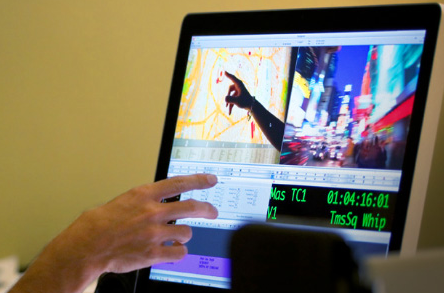
John Underkoffler is one of the great visionaries of UI design, and he’s just posted his talk about 3D spatial interfaces from the TED conference this year. This is the Minority Report UI (which he helped design) as it is being implemented — in reality — now. I had the great privilege of sitting in on his class at USC recently, where they were prototyping an editing application. My reaction at the time — it’s a slam dunk. The details don’t really matter. If we could have it, we’d use it. Take a look at his video (at TED or on YouTube) and start thinking about what computer interaction might be like sometime soon. And tell me that you don’t want it now.

Meanwhile, touch interfaces just got a lot more real for post-production with the release of iMovie for the HD iPhone. Apple has made it possible to shoot and edit on one small device and to do the whole thing via touch (and for a measly $5). It’s not for pros, of course, but it points the way.

MC5 will be released in a couple of days, and for the moment, things are pretty exciting in the world of non-linear editing. But these applications point to a different, more fundamental transformation — toward natural interfaces. Just when you thought things couldn’t get more interesting, the world shifts on its axis, and everything you know is wrong.

MC5 Rides Again

Posted June 2, 2010 by Steve
Categories: Avid, Avid vs. Final Cut

Media Composer 5 will be released a week from tomorrow, and without question, it represents the biggest upgrade Avid has offered in years — since the last version 5, to be exact, way back in 1994, when the modern Media Composer was born. The symmetry is the result of Avid resetting its numbering scheme in 2003. So here we are at version 5 again. Five was — and is — a very good number for Avid. I can still remember the cheering at the user group meetings. I wouldn’t be surprised if we see that same excitement this time.

This version brings timeline changes that should appeal to the Final Cut Pro crowd and that arguably go FCP one better, making it easy to grab-and-drag in the timeline without monkeying with a tool palette. That’s because Avid’s new tools are smart, and let you select a segment or a transition or a keyframe without a trip to the toolbar. You can also stay in what used to be called Segment Mode and move around without losing clip selection.

Other changes include realtime audio effects, stereo tracks and clips, advanced keyframes for most visual effects and automatic image stabilization. And, of course, Quicktime AMA, which means that you no longer have to import and transcode Quicktime materials. Not every format is equally responsive, but with the right codec and the right hardware you won’t need to import. Red (R3D) material is handled natively, too, along with Canon DSLR material.

Meanwhile, Avid has blessed a Matrox box as a low cost monitoring solution, and announced a software developer kit for other hardware manufacturers, which means that one of these days there will probably be a choice of non-native hardware offerings for Avid folk.

And, of course, there’s the student price of just $300 for the full version, with four years of free upgrades. And a 30-day downloadable free trial for everybody else.

All in all, this is an exciting time for Avid. I’ve been beta testing the new version and working full time on a new Media Composer book, titled Avid Agility.  With luck, it’ll be available on Amazon by mid-July. I hope you’ll find it essential reading.

Meanwhile, I’ll be demoing MC5 at the LA Final Cut Pro User Group, on Wednesday, June 16 at Barnsdall Park.

It’s only the 2nd of June, and already it’s shaping up as a very interesting month.

Irony for the Holiday

Posted May 31, 2010 by Steve
Categories: Media and Society

I had thought that one big win for the internet, in terms of its social implications, was that it lets viewers be more active. Instead of sitting on the couch narcotized by the drug in front of you, you surf, make choices and actively explore. Internet utopians (and we’ve all drunk that kool-aid in one way or another) have touted this for years. It will change our consciousness, make us smarter, wiser. It will reduce the power of advertisers and networks and yes, even governments, to manipulate us and control what we think.

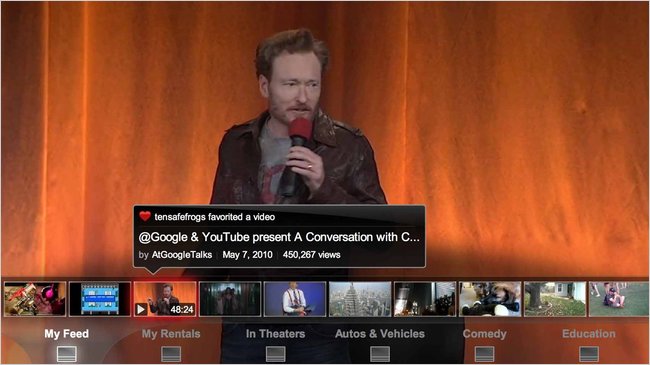
Well, now it seems that YouTube isn’t so happy with the active nature of internet video consumption. Why? Because it’s not so great for … advertising. What they really want is a passive audience: people that will sit still on the couch without leaving or changing a channel or clicking a mouse. They’re developing YouTube Leanback. (Yup — Orwell could not come up with names like this. They’re too good.) Quoted in a NY Times article Sunday, Jamie Davidson, a YouTube product manager, says, “We’re looking at how to push users into passive-consumption mode, a lean-back experience.” They want to limit “decision points” — moments between videos when you might click that mouse and go elsewhere. “There’s no browsing, no searching, no clicking.” said Hunter Walk, a YouTube program manager.

NowMov, a startup in San Francisco, offers a preview — popular YouTube videos streamed continuously. “If too much of your brain is occupied with the process of choosing, it takes you out of the experience of watching,” explains James Black, a NowMov co-founder. His goal is to free users from “the tyranny of choice.”

Yea, I guess that’s it. What’s wrong with the internet? Too much surfing.