iMovie as a Gateway Drug

Posted August 19, 2007 by Steve
Categories: Consumer Editing, User Interface, Workflow

The new iMovie seems to represent a different paradigm for consumer editing — faster, less precise, designed for a tapeless workflow. It was discussed in some depth on last week’s MacBreak Weekly podcast and the consensus there was that it might be very useful for quickly throwing together a super-rough cut. It has one very important secret weapon: “Export to Final Cut Pro.” If you’re missing something, and iMovie ’08 is missing a lot of things, then you get yourself Final Cut Express or Final Cut Studio and move your project straight into it, courtesy of XML and Quicktime.

The program seems to be extremely easy to learn. It doesn’t offer a lot of options — it just does the right thing. For example, if it sees a mounted digital video source it just starts importing video from it, no questions asked. We may see producers or directors creating rough “idea” cuts in iMovie, and then handing the thing off to real editors who can make it work. (But there are problems, too. Scott Simmons has posted some interesting observations on his site.)

Rhetorical question: Is there an upgrade path from Pinnacle Studio to Media Composer? I don’t know for sure, but I’d have to wager that the answer is no. You can move a project from Studio to Pinnacle’s Liquid line. But that just begs the question. Doesn’t Avid want to see young editors moving all the way up to Media Composer?

Technorati Tags: , ,

Consumers, Students and Editors

Posted August 17, 2007 by Steve
Categories: Avid vs. Final Cut, Consumer Editing, User Interface

One key issue that Avid and Apple are both facing is the synergy between different groups of editors. Based on the applications they sell, Apple thinks there are three groups: consumers, “prosumers” and professional editors (of all types) — iMovie, Final Cut Express and Final Cut Studio. There’s a clear migration path from FCE to FCS but iMovie is separate.

Avid also has a consumer product that’s completely separate from its other offerings — Pinnacle Studio. And with at least three families of professional editing applications and many subtle variants, Avid wants to view the pro world as heavily segmented. (I’ve argued before that all these offerings confuse and frustrate customers and hurt the brand.)

Most of the young editors arriving in Hollywood already know FCP. Generally, my advice to them is that if they want a career editing long-form, narrative films they need to learn Media Composer. There just aren’t many high-end projects that are cutting with FCP. You can argue that this is because us Hollywood types are old curmudgeons, but I’d counter that, for all its many strengths, FCP is just not as good as MC with narrative material.

Nevertheless, FCP has made editing sexy to young filmmakers and the fact that they all seem to know that application represents a tide that will inevitably have its effect at the higher end.

But consider the consumer market for a moment. Wouldn’t Apple and Avid want to see young people learning their preferred interface as early as possible? Apparently not. Both companies seem to think that whatever people are using at home, when they get serious they’ll be willing to learn something new — and hopefully something that isn’t made by the other guy. iMovie at least shares the look of Apple’s pro aps, which might engender some brand loyalty. But mostly, it’s a radical redesign. Pinnacle Studio has next to nothing in common with Media Composer.

Does this represent a failure of imagination? Or … is the new iMovie so fast and intuitive that kids who cut their teeth with it will expect something equally slick when they need more — something that nobody makes yet?

Technorati Tags: , ,

How much editing does the average person need?

Posted August 15, 2007 by Steve
Categories: Consumer Editing, User Interface, Workflow

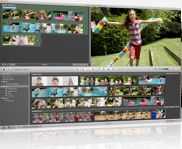
imovie screen shotWhen Apple didn’t release an upgrade to the iLife suite at this year’s Macworld, some people speculated that an announcement would have stolen focus from the iPhone, or that perhaps the new version was only going to work with Leopard. But now that iLife ’08 has been released, I think the reason might have been that it just wasn’t ready. An awful lot of work has gone into these applications — a new level of interface slickness and integration.
You can watch an excellent introduction to the new features here: iLife 08 Guided Tour. Apple has been moving to slick, highly produced, video-based tutorials. This one not only gives you a look at all the new features, but offers useful information and training. (Avid is putting up free training videos, too. Check them out here: Media Composer videos.)

My first impression of iLife is its user focus. They’ve consistently asked “what does the customer want to do” and answered it throughout the program. From a development standpoint, It’s always easier to ask “what can the machine do?” Apple’s approach can limit choices, but if done right, it’s much more intuitive for the user. That takes time, money and vision.

iLife, like the recent changes to the Final Cut Suite, focuses on high-bandwidth visual feedback. For example, they now offer something called “skimming.” Click and drag on a clip in iMovie to shuttle through it. Move your cursor over an image in iPhoto to flip through all the images in a gallery.

Overall, iMovie is the biggest surprise, because it’s been completely rewritten. It’s now designed as a library manager, more like iPhoto and iTunes, and as a way to quickly slam cuts together, add some music and automatically publish the results to the web. The old iMovie was very DV-centric. The new version seems to be format-agnostic. And it adopts Apple’s new media application look and feel — dark backgrounds, lighting effects on surfaces.

There’s been a lot of debate (for example, here and here) about the new iMovie, primarily because many capabilities have been eliminated. For starters, there’s no timeline at all. And there are far fewer visual effects (but none require rendering). You select material by simply dragging over a clip icon, so precise editing is nearly impossible. My sense from the guided tour is that the program excels in the kind of quick and dirty editing we see more and more now, and I suspect that it will appeal to many people.

Though I like the browsing and publishing features, with such limited editing controls I doubt that I’ll have much use for it. But it represents a vision of what the consumer wants, and whether it succeeds or fails I have to give Apple credit for aggressively rethinking entrenched ideas and trying something new.

Technorati Tags:

LA Avid User Group Meeting

Posted August 13, 2007 by Steve
Categories: Avid

The Los Angeles Avid User Group is holding its August meeting this Wednesday, August 15 at Moviola, from 6:30 to 9 pm. ACE President Alan Heim will be the featured speaker. Coby Rich from Sorenson Media will also make a presentation.

Moviola
1135 N. Mansfield Avenue
Hollywood, CA 90038
323-467-3107

Details here.

Another Multi-Touch Rumor

Posted August 10, 2007 by Steve
Categories: User Interface

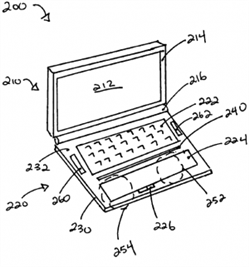
Ars technica reported yesterday on a new Apple multi-touch patent, this time for a laptop equipped with a wide touch pad stretching across the bottom of the entire keyboard. I find this particularly tantalizing because most multi-touch implementations are based on the idea that you’d touch the screen itself. That presents some real problems about where you’d want to put the screen. Is it angled like a drafting table? Is it hanging in the air? Either way, you end up with awkward body positions and fatigue and you can’t use a mouse. I expect that we’re going to see some kind of hybrid environment where you’ll use your hands to manipulate some things (like scrolling and scrubbing video or grabbing and moving trim boundaries) and a mouse for more precise control. This filing gives a hint of what such an interface might look like. It’s an incremental change and seems like it might be usable sooner rather than later.

For those of you are wondering where I’ve been this week, I was speaking at the University Film and Video Association Conference at the University of North Texas. Norm Hollyn and I did a “conversation” to kick off the event, focusing mostly on issues of collaboration. Partly because editing software now seems to allow you to be a one-man band, it may be that film students are not always learning the collaborative skills they’ll need on big productions. Of course, collaboration is always, in some way, ineffable — every relationship is different and rules are hard to come by. No editor wants to be a “pair of hands,” as we used to say, but, on the other hand, we rarely have complete control. Finding a happy middle ground is at least half the job, maybe more.

The 700 MHz Auction — The Biggest Media Story You’ve Never Heard About

Posted August 2, 2007 by Steve
Categories: Media and Society

A decade ago, the US media landscape was transformed by the 1996 Telecommunications Act. This loosened the ownership requirements for big media corporations and ushered in today’s communications landscape dominated by a few huge players, disgruntled customers, and increasingly limited news sources. And it laid the groundwork for the transition to HD TV.

But, if you’re like most Americans, you’ve never heard about this law. Why? Because the corporations that you get your news from decided that you didn’t need to know about it. Or maybe because they thought it was too complicated for you. Either way, it was barely covered anywhere.

Flash forward to this week. The HD transition is almost complete. The networks were given a huge swath of spectrum to use for HD signals. This was estimated to be worth upwards of $50 billion in 1996, but it was given away free in exchange for the existing spectrum, the airwaves used to broadcast analog TV. Never mind that the HD spectrum can be used to show five channels while the old spectrum is good for just one.

The networks have been using the HD spectrum for several years, and now they have to return the old airwaves. The FCC will auction off this 700 Megahertz band to the highest bidder. And they will make rules for the auction, rules that will affect the ways we communicate for decades to come.

Add to this tasty stew the fact that the US cellphone system is far less flexible than what consumers are used to in Europe. Network neutrality — making sure that all broadcasters are treated equally — is common there. And in Europe phones and carriers are independent. The system works like your landline phone — buy your phone at Costco, plug it in and start talking.

Enter Google. Google has been talking about bidding for the 700 Mhz spectrum and they’ve advocated a set of auction rules designed to open up competition for broadband wireless services.

Meanwhile, a quarter of a million Americans have filed comments with the FCC, urging an open auction that will preserve competition and make sure that the spectrum doesn’t end up getting used in a closed, proprietary way.

Finally, enter the FCC. The five commissioners have more power over your media experience than just about anybody. But again, you probably couldn’t name even one of them. The Democrats, Jonathan Adelstein and Michael Copps, have generally been in favor of net neutrality and an open broadband system. The Republicans, Deborah Taylor Tate and Robert McDowell, usually come down on the side of corporate interests. The fifth and often deciding vote is the chairman, Republican Kevin Martin. Usually an industry guy, in the 700 MHz auction he’s supporting a compromise. The rules were decided on Tuesday, and details haven’t been made public, but they will apparently give Google some of what it wanted. Many consumer groups think that the FCC didn’t go far enough. The auction itself will start some time before the end of January.

For more on this subject check out SpectrumPolicy.org and SaveTheInternet.com.

For details about recent developments, check out these articles: Save The Internet, NY Times, Ars Technica #1, Ars Technica #2.

This may sound like arcane stuff, but how you will use the Internet and your cell phone for years to come depends on the lobbying of big corporations working behind the scenes with government. It behooves us all to learn about what’s going on and what the stakes are — even if the major media outlets don’t think we’re interested.

Technorati Tags: