Archive for the ‘Avid vs. Final Cut’ category

Why Are Our Mixing Tools So Bad?

March 16, 2007

A couple of days ago I sat beside a friend while he did a one-day temp mix on a Pro Tools. We were shoulder to shoulder in a small room and that gave me a chance to learn a lot about how PT works.

Over the years I’ve been struck by how many feature and TV editors refuse to use Avid’s volume graphing features. Instead, they simply make add-edits in audio clips, set levels on the clips and connect them with a dissolve. I use keyframes and can’t see why others don’t. I recently debated this with a friend and she focused on how you change a volume graph. And she made some good points. In fact, it is easier to move a series of volume changes when you do them with add-edits and dissolves — you do it by slipping them.

I was thinking about all of this while watching my friend mix. It turns out that Pro Tools has a whole host of mixing features that I’d kill for in my Avid. There’s a reason that so many people use this program.

For example:

  • Waveforms are on all the time, they’re very detailed, and there’s no performance penalty for looking at them. Why have we waited so long for this?
  • Background saves. You can work all day and never see the system saving. But the saves are happening, and at any time interval you like. You get the PT equivalent of the attic, too. You just don’t have to wait while the save takes place.
  • As many tracks as you like. No artificial limitation.
  • The ability to easily mute a clip.
  • The ability to “nudge” a clip. Want to move something a frame to the right? Just select it and tap the arrow key. (Final Cut has this feature, and muting, and unlimited tracks, too.)
  • You can “spot” a clip into position by just typing a timecode onto it.
  • You can mix and handle a stereo pair (or a 5.1 mix) as a single object with one set of keyframes. You don’t have to laboriously create (and adjust) two separate volume graphs.
  • You can raise one or more keyframes, very precisely, by dragging them with the option key.
  • You can grab a whole series of keyframes and move them up or down by dragging, and when you do it you see a clear numerical display showing you what you’re doing in DBs.
  • You can move a group of keyframes in time (left or right).
  • Keyframes can be created automatically. In the Avid, to lower a section of music you have to create four keyframes and then move two of them. That’s a lot of clicks and drags. In Pro Tools you just mark two points and drag the line between them.
  • You get a separate graph for panning. So you can pan something just by dragging the graph and you can move a sound from one place to another easily.
  • You can route (bus) all your dialog into a single track and mix that track as a whole with a single volume graph. You don’t have to individually manipulate the volume of every single clip.
  • You can copy automation and filters — everything — from one clip to another. So if you carefully mix a piece of music against dialog and then need to replace it, you can keep your mix and just change the cue.
  • And — eureka! — the timeline is live. You can scroll it vertically or horizontally, change magnification, change views, all while your sequence continues to play.

Avid has focused much of their development effort in the last decade on visual effects, while the audio interface has largely remained untouched. Today, our sound tools just don’t reflect the kind of work we’re routinely asked to do, and they turn temp mixing into a real chore. Meanwhile, the upgrade rate in LA has been glacial. Bringing over only a few of the features listed above might just get the attention of a lot of editors.
Technorati Tags: , , ,

What’s Avid Up To?

March 15, 2007

What does the recent Avid Insider seminar mean to editors? That depends on how you think it fits into Avid’s plans for NAB next month. The seminar itself was well done, and the company certainly has been busy, but what we saw was mostly focused on workgroups.

It’s possible that will be some surprises in April, but if this was an NAB preview then there just isn’t that much in the way of bread and butter features for editors to get excited about. Specifically:

Avid Interplay is an interesting product but it wasn’t designed for typical feature and TV cutting rooms. For reality TV and large installations it’s another story. If you are trying to coordinate the work of dozens of editors, producers and writers, or have to handle lots of new visual effects every day, then you need something to help you, and Interplay might be that thing. Unfortunately for editors, it requires the learning of yet another user interface and frankly, one that looks awfully crude and Windows-centric.

DNx36 is probably going to be adopted in a lot of cutting rooms and for Avid folks it’s going to represent a small revolution. But editors have been cutting compressed HD for some time with Final Cut, using DVCPRO. Avid’s codec is arguably superior, but the process is nothing new. It requires Adrenaline, so adopting this format will nudge editors and facilities to trade in their old Meridien machines.

Automatic script mimic is a very slick idea and I certainly plan to try it out. But, so far, the large majority of editors haven’t been attracted to Avid’s script tools and I’m not sure whether this will sway them.

A realtime burn-in effect for timecode and footage would save cutting rooms a lot of time, but it’s not here yet and we’ve been waiting for a long time.

Avid running on Intel-Mac should be released any day now. That’s probably the biggest news for editors and it should help make our machines, particularly our portable machines, run a lot faster. But like all Avid products, it’s probably going to be buggy at first, and for that reason, the adoption rate is going to be slow.

That leaves Avid Satellite, which seems like a good solution for Pro Tools video until you realize that it costs roughly $6,000 per seat. I expect that many sound and music editors, when told what the ante is, are going to decide that Quicktime is plenty good enough.

What was missing in all this were new usability features for editors. A new title tool, new mixing tools, a live timeline, background saves, automatic backups — the list is long, and I’m sure you all have your favorite items for it.

Instead, the changes we’re seeing mirror the kinds of things that came in with Meridien, namely improved speed and image quality — along with a lot of new bugs and quirks. Editors never got excited about Meridien, and we’ve largely been staying away from Adrenaline for the same reasons. That can’t be good for Avid’s bottom line.

There’s plenty on this list to think about and some of it will certainly be used widely. But at the same time. I’m struck by the fact that while Avid continues to avoid changing the core application, Apple pushes the envelope, bringing out major new features, or whole new applications, almost every year. To some extent they have to do this, because they’ve been coming from behind. But that time is ending. Though I still prefer Media Composer, both applications are now roughly similar. And with Final Cut you get DVD Studio Pro, Motion, Compressor and Soundtrack.

The question now is what each company will offer at NAB. Rumor has it that Apple will show a beefed up Final Cut, able to play, cut and conform 4K materials, perhaps running on an 8-core Mac Pro. That’ll be a show-stopper for sure.

Technorati Tags: , , , ,

NAB Speculation

March 2, 2007

A report today says that Apple is planning to hold a media event at NAB on Sunday April 15th, the day before the show floor opens. There are several things that could be announced, including details about what Apple is up to with Shake, or Logic, or with the color correction software FinalTouch. The company could also announce upgrades to the Mac Pro desktop machines, which are overdue. There’s speculation that we’ll see an 8-core system based on a pair of Intel’s new quad-core CPUs.

But the big question is what’s in store for Final Cut Pro. Final Cut 6 didn’t make it out of the labs last year and it seems almost certain that we’re going to see it in April. But what it will include, nobody knows. We’ve also been hearing rumors for a year now that Apple is working on something called “Final Cut Extreme,” which will be able to handle 4K materials and thus become an inexpensive and very capable finishing system. That might dovetail nicely with an 8-core MacPro.

The question is, what is Avid up to? Next Tuesday (3/6) the company will hold a seminar at the Skirball center in LA to showcase some of its new stuff. The agenda includes info on Avid Interplay, high def offline with DNxHD 36 media and improvements to script based editing with automatic dialog recognition. It should be very interesting.

Technorati Tags: , , , ,

Open Standards

March 1, 2007

I just finished reading an article in the Editors Guild Magazine about the making of “Zodiac.” It’s pretty hard to figure out exactly what they did, but the general outlines are there and they reinforce a lot of what I’ve been saying in recent posts, namely that file-based workflows are coming at us very quickly.

The show was shot with the Viper FilmStream camera and used Final Cut Pro in the editing room. The editors were responsible for archiving and cataloging the original camera source files, for down-converting those files to DVCPRO HD for editing, and, apparently, for conforming the show back to 2K for the DI. They also did some color correction using FinalTouch. In other words, the cutting room took on a lot more responsibility than is traditional. That’s good news for assistants because there was certainly plenty of work for them, but if this workflow takes hold it also means that assistants and editors have a lot of learning to do.

If everything’s going to end up as files, then much of the work on a show will turn on how we handle, store and move these things, and, most important, how they translate from one program to another. And here, I worry about Avid. The company has stuck with closed standards for a long time now. That made sense in the old days when people wanted something that was totally supported and really worked. We still want that today, of course, but more and more, we want to be able to pick the best software for the job and move materials back and forth transparently.

In that environment, Avid’s closed approach looks more and more anachronistic. Avid bins can’t be opened by other programs, Avid visual effects don’t translate into anything except Avid products, Quicktime export and import is slow and confusing, and even Avid sound files can be hard to share with all data intact.

On the other hand, the Media Composer still has many advantages, and Avid tends to understand our work very well. This stuff is still new, and there are plenty of hiccups on both sides of the aisle. But it’s easy to see that the company that gets this right is going to have a big advantage.

Technorati Tags: , , , ,

What’s Wrong With the Title Tool?

February 25, 2007

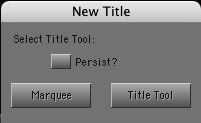
new_title.jpgActually, it’d be much easier to talk about what’s right with it, because the list would be so much shorter: it makes titles that can be supered over picture. Wow. That was an exciting thing a decade ago. Today, we see the same bugs, the same quirks, the same limitations that have been there all along, namely:
  • Titles play in realtime, but they’re not realtime. The title master clip must be rendered.
  • Changing a title always means creating a new render file and these files tend to proliferate and end up all over the place.
  • You can’t matchframe on a title in order to modify it. (The error message says “Precomputes can’t be loaded into monitors.” Of course, that isn’t true — you can load a title into a monitor.)
  • Unlike every other kind of clip, modifying an existing title means modifying only that single instance of it, not the title master clip.
  • Unlike every other kind of clip, modifying the name of a title master clip doesn’t change the name of the title when it’s edited into a sequence.
  • Change the text in a title and you often change the dimensions of the title’s bounding box and cause line breaks to change unpredictably.
  • Typography is a mess. Letter spacing is inconsistent and individual letter pairs often have to be kerned by hand. Type can look crude and rough.
  • Leading can only be changed for an entire title block, not line by line.
  • No lighting effects are possible.
  • It’s hard to precisely control title color.
  • Animation is crude and difficult to control.
  • Soft drop shadows are now possible, but are difficult to control.

And don’t get me started on Marquee, which is, if anything, even worse. Marquee’s typography is much better, but it’s got plenty of quirks of it’s own. For example, you can easily create multiple instances of Marquee, where two copies of the program are running independently — a total no-no in the Mac world. And I challenge anyone reading this, who doesn’t already know the trick, to tell me how to change the leading in a Marquee title. Or modify a Marquis-created title (hint — make your change and then quit Marquee!) Or figure out how to do simple character animation with it, which is supposedly what it’s for.

When are we finally going to get titles that don’t have to be rendered? When are we going to get real title styles, so we can simply change a style and have all the titles that use that style change together? So you could change the font, say, for an entire main title sequence in one step? When are we going to get soft drop shadows that are easy to apply, control and change? When are we going to get easy-to-use character animation?

I suspect that some of the folks in Tewksbury are painfully aware of all this. At one time I had hopes that we might see something new at this year’s NAB, but my intuition is that the challenge of getting the Media Composer onto the Intel-Mac platform has consumed a lot of engineering man-hours.

And so Media Composer users wait. Meanwhile, Final Cut and Motion get more capable, more responsive and more intuitive.

Technorati Tags: , , ,

Running the MC at Home

February 2, 2007

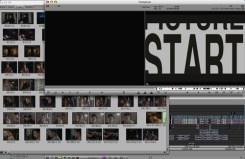
Overlapping WindowsI’ll be buying a new machine to replace my aging G4 shortly. My goal is to make this my primary computer at home — and I’d also like to be able to do some editing with it. Avid doesn’t make this easy, in at least two ways.

First, the company is always late to the party with operating system compatibility. With an Avid installed on your machine you are well advised to upgrade the OS with great care, lest you make your Avid flaky or nonfunctional. Avid blames this on Apple and I’m sure there’s something to that, but it still feels less and less acceptable these days. I just don’t have other applications that are this fussy. Somehow, virtually every other software manufacturer is able to deal with changes in the OS more quickly than Avid. Even Digi does a better job.

The second problem lies in the way Avid handles non-standard monitor configurations. The Media Composer was designed to work with two monitors, each with a 4:3 aspect ratio. You put your bins on one and the composer (the source/record monitor) and the timeline on the other.

Two 4×3 monitors was state of the art in 1991, but not today. We’ve got much bigger screens available and it ought to be possible to work comfortably with just one of them. Both Avid and Apple allow you to put your windows wherever you like them, so — problem solved, right? Wrong.

The trouble lies in window activation. Apple’s laptops and big monitors all have aspect ratios of about 16×10. But two 4×3 monitors next to each other have, in total, an aspect ratio of 16×6. In other words there’s a lot more width. If you try to jam bins, composer and timeline into 16×10 what you get is overcrowding. Either you make your bins very tall and narrow, or you overlap your windows. Overlapping shouldn’t be any big deal — except when you try double clicking on a clip. Your shot opens in the appropriate monitor, and the composer window comes forward. But the timeline stays where it is, behind the bin, creating the mess you see in the image above. So every single time you put a clip in a monitor, you’ve got to click again on the timeline in order to actually do anything with that clip. This may seem like a small thing, but anybody who has tried to cut on a laptop, and look at their bins in frame view, knows how annoying this can be.

Final Cut works differently, but isn’t much better. In FCP the viewer and the canvas are separate windows. That can be helpful in certain situations. But in this case, it just confuses things. If you double click on a source clip the viewer comes forward — but not the canvas and not the timeline. If you double click on a sequence, you get the canvas and the timeline, but not the viewer. In each case you have to click again to to do something useful.

People who work with their bins in text view are probably okay with this setup — tall and narrow bins are fine when you’re just looking at text. But I don’t work that way and neither do a lot of people I know. It shouldn’t be much of a challenge for the engineers to change this kind of behavior. The question is, as always, “What does the customer want?” This one is easy — just make window activation a preference. That would make it a whole lot simpler to work on diverse displays and it would make it a lot easier for me to buy a new monitor, too.