Archive for the ‘Avid’ category

Editing in the Cloud

April 17, 2010

Another tidbit from NAB — a demo of Avid’s online, editing-in-the-cloud product. Just a technology demonstration, but it’s pretty darn impressive. If it was simply another editing application it wouldn’t be all that interesting, but all of the media and all of the editing action is taking place on a server thousands of miles away. All your cuts, including up to four layers of visual effects, get transparently assembled and composited on the server at DNxHD 220 and then transcoded and sent to you as you work. Very little latency. Background rendering and distribution. There’s even an iphone application for review and approval.

Product Manager Richard Gratton does a very tight, well-paced demo. It’s about 20 minutes long:

m4v file download / video podcast on itunes.

More MC5 Features & Videos

April 14, 2010

Adding to the list from yesterday, here are a few more new features in Media Composer 5:

  • The ability to select timeline views from the keyboard (hallelujah!).
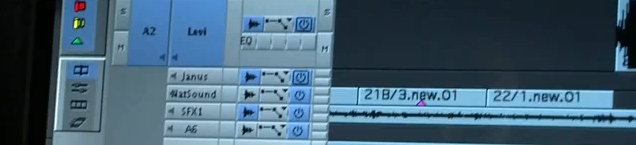
  • Separate solo and mute buttons for each audio track.
  • Ability to turn on waveforms for each track independently.
  • Ability to deactivate any audio track to save system resources (this is different from hitting the old speaker icon — which didn’t really deactivate the track).
  • Standard “landing bar” for the timeline cursor — at the top of the timeline window.
  • Not only does linked selection work in segment mode, it also works in trim mode. When it’s on, if you select video for trimming, audio is selected, as well (and vice versa).
  • Red support means that you can directly play R3D files and also apply and change color value information using a histogram (and in your choice of colorspaces: REDSpace, Camera RGB, and REC.709).
  • And last but not least, AMA support for native ProRes files.

Avid’s Bob Russo does a good job demonstrating most of the new features in this 5 minute youtube video.

And in a this 15 minute video podcast from the Avid booth at NAB, Matt Feury goes over the new features (and some old features) and shows how they work together in the editing room. Avid Events Rewind Blog. Same thing on iTunes.

Media Composer 5

April 11, 2010

With NAB starting this weekend, Avid has announced Media Composer Version 5. You can get a quick rundown on some of the new features, here and here. Without doubt, this is Avid’s biggest upgrade in years and includes many fundamental changes to the editing model, along with a host of new features.

The short list includes:

  • AMA support for Quicktime, for native Red R3d material and Canon DSLR media — meaning that you can play and edit these files without importing them.
  • Super low cost HD client monitoring via the Matrox MXO2 Mini (about $450).
  • Direct manipulation of clips and transitions in the timeline. Click a transition to get into Trim Mode, click a clip to get into Segment Mode. Click the top of a clip for red segment mode, click the bottom for yellow segment mode.
  • Linked selection — select video and the associated audio is selected at the same time.
  • Stereo audio tracks and clips — a stereo pair can be treated as one object with one set of keyframes.
  • Support for real-time Audiosuite plugins.
  • The ability to mix and match clips with different aspect ratios in the same timeline. Tell the MC how you want each clip presented via a bin column (pillar/lettter box, stretch, etc.)
  • A “paging” timeline — when you play off the right edge of the timeline, it jumps forward, so you are always seeing the blue cursor. (This alone is a reason to upgrade.)
  • Dupe detection now works across all video tracks.
  • The ability to import AVCHD video.
  • Support for RGB colorspace in HD.

Not too shabby for one release.

And, in a separate announcement, Avid reported a deal to buy Euphonix, maker of advanced mixing consoles. The press release is here. Key sentence: “Avid plans to further develop an open standard protocol that greatly expands the ecosystem of compatibility between the Euphonix control surfaces and a wide range of Avid and third-party audio and video applications, including Media Composer and Pro Tools.”

Conforming on the Desktop

March 12, 2010

NAB is only a few short weeks away, and I’ve heard very little about Adobe’s Mercury technology, slated for a “future release” of Premiere Pro. There’s a video demo and a blog page on the Adobe site (and a couple of other videos here and here), but no word of when the technology will make its appearance in a product you could buy.

I looked at the demo again the other day and despite its over-hyped style, it seems even more impressive the second time through. (My first post on the subject is here.) Will they release it at NAB, as part of Adobe CS5? If so, I think they’re going to make some waves. The demo shows the editing of 9 streams of P2 media —  each carrying a 3D effect. And it shows live multicam editing of 4K native red files. Yes — four streams of 4K Red (though it isn’t clear how much debayering they’re doing, which is critical). All this on a well-equipped PC with a $1400 video card (and what looks like 24 Gigs of RAM). As a little bonus, they demonstrate multi-stream playback of native AVCHD files and the ability to ingest and edit native digital SLR video.

I haven’t edited anything with Premiere. But from the demos I’ve seen the product is a study in contradictions. It can handle all kinds of files in their native state and can transcode and output to other formats in the background. It can directly import After Effects projects. It can do digital dialog transcription. But trimming is badly crippled. It has a cluttered interface that wastes too much space on video controllers and timecode displays. And it seems to have zero film support.

Of course, we won’t know how Mercury shapes up until after it’s released. But even if there are problems, it points toward a world where 4K editing and conforming will become commonplace. Whether we see it at NAB or not, it looks like 4K is coming soon to a desktop near you.

Avid Receives ACE’s First-Ever Tech Award

February 15, 2010

The American Cinema Editors held its 60th annual Eddie awards ceremony last night with Bob Murawski & Chris Innis taking home the prize for “The Hurt Locker,” Debra Neil-Fisher winning for “The Hangover” and Kevin Nolting winning for “Up.” Alan Heim and Lee Percy won for “Grey Gardens.”

The ACE awards just seem to keep getting better, and this year the presentation was consistently entertaining, with a lot of humor and, at times, some rather edgy patter. I offer all the winners my humble congratulations.

From a tech-centric point of view, the highlight of the evening was ACE’s first-ever Technical Excellence Award, which went to the Media Composer. Avid CEO Gary Greenfield was there to receive it, and many Avid folk were on hand to share in the festivities.

The technical Eddie couldn’t have been awarded at a more appropriate time. Avid has made a remarkable turnaround in the last couple of years, and the Media Composer has come a long way very quickly. Congratulations to all those at Avid who helped make it possible.

The Winners Were:

Feature (Dramatic)
The Hurt Locker – Bob Murawski & Chris Innis

Feature (Comedy or Musical)
The Hangover – Debra Neil-Fisher, A.C.E.

Animated Feature
UP – Kevin Nolting

Half-Hour Series
30 Rock: “Apollo Apollo” – Ken Eluto, A.C.E.

One-Hour Series for Commercial TV
Breaking Bad: “ABQ” – Lynne Willingham, A.C.E.

One-Hour Series For Non-Commercial TV
Dexter: “Remains to be Seen” – Louis Cioffi

Miniseries or Motion Picture for TV
Grey Gardens – Alan Heim, A.C.E. & Lee Percy, A.C.E.

Documentary
The Cove – Geoffrey Richman

Reality Series
The Deadliest Catch: Stay Focused Or Die – Kelly Coskran & Josh Earl

Student Editing
Andrew Hellesen – Chapman University

Career Achievement
Neil Travis
Paul LaMastra

Golden Eddie
Rob Reiner

Technical Excellence
Avid Media Composer

Gigabit to the Home

February 12, 2010

On Wednesday, Google announced plans to build a pilot project that will install high speed fiber-to-the-home in select locations. They’re projecting gigabit speeds for this network and are planning to open it up, meaning that they’ll lease it to many service providers. I once participated in a workshop that demonstrated the use of cable TV wiring to bring digital information to the home. This was several years before I’d ever seen a browser, let alone a cable modem. The inventors thought they could provide a gigabit of speed, and to them, a gigabit was the holy grail, the speed at which everything changed. Today at 5 megabits, we’re getting less than 1% of that.

Google has only proposed a pilot project and it may be a while before anybody actually uses it. Still, the idea is tantalyzing, and, given enough time, inevitable. The major fiber-to-the-home scheme available now is Verizon’s FIOS. It offers 15-50 megabits.

Imagine that your connectivity is 100 times faster than it is now. And that you could buy it from multiple providers. That’s going to change digital editing in fundamental ways, making real-time remote collaboration possible and forcing editors to compete with each other worldwide. What would you do with speeds like that?

For more, see the Google Fiber for Communities page, or this article at Ars Technica. Use this link to nominate your community for the test.