Archive for the ‘Avid’ category

More on the Hollywood/Avid Disconnect

December 18, 2006

For the moment, it looks like most of the people visiting this site got here from a link on the American Cinema Editors home page. If that’s true, then many of us are ACE members. If you agree with me that Avid hasn’t added features that appeal to us in a long time (see previous post), then you have to wonder what we can do about it. It’s not that the machine can’t be improved. That’s just silly. There are plenty of things that frustrate us, and many of them have been around for years. My contention is that we’re engaged in a vicious circle: we don’t upgrade very often because we don’t see a reason to, and Avid doesn’t see a lot of upgrade money coming in so they think we’re happy and end up ignoring us.

The solution is to come together around some changes that we’d like to see. My impression is that a little bit of consensus might go a long way.

That’s why I’ve been posting some “Wish Lists” here, organized by topic. There are two so far, and a third is coming in a few minutes. (You can find them by clicking on the category “Avid Wish List” on the right side of the home page, or you can click here.)

I’d like to hear your thoughts. If we can find some consensus it might be a lot easier to get things done.
Meridien, Anyone?

December 13, 2006

Hollywood editors often function as Avid’s poster children — and deservedly so. Despite Final Cut’s inroads into many markets, LA remains primarily an Avid town. But our dirty little secret is that many, and perhaps most, TV and feature editors are still using Meridien systems and don’t want to upgrade. Despite the fact that Adrenaline was introduced nearly four years ago, long-form editors have heard that it’s buggy and slow, and they don’t see a strong reason to switch.

This situation mirrors the one we saw with Meridien. It took Hollywood years to make that move and the town only switched en masse when Avid stopped supporting ABVB. The perception then was that the new version didn’t offer anything important enough to compensate for the pain and expense of an upgrade.

Avid has made much of its terrific user interface and hasn’t wanted to tamper with it. Instead, the focus has been on improved visual effects and finishing capabilities. While these things are wonderful, long-form editors tend to be more interested in bread and butter editing features: the things that help us turn hundreds of thousands of feet of film into coherent stories. And those capabilities, warts and all, haven’t changed much in over a decade.

I’ve used Adrenaline or Xpress on three shows now and would choose it again without hesitation. But I have to wonder how a glacially slow upgrade pace affects Avid and its Hollywood user base. The company can’t get useful feedback because so many of us are using old machines. And Avid isn’t making the money from us that it could be. The result is a self-reinforcing feedback loop. Editors are so certain that nothing will change that they have long since stopped asking for improvements. And Avid isn’t asking because we’re not upgrading.

Editors once drove the upgrade cycle and new features would elicit thunderous applause at user group meetings. That can happen again, but Avid needs to put more focus on figuring out what people like me want and need. The kinds of things that motivate us might not be all that hard to do. For many people here, the most desireable improvement in Adrenaline is the ability to play 16 tracks of audio and use real-time audio dissolves. Not exactly rocket science anymore.

Avid took a commanding lead worldwide in the ’90s partly because the Media Composer won in Hollywood. I hear that the Intel/Mac Media Composer is very fast and I’m hopeful that we’ll see new features introduced in April at NAB. But Avid isn’t going to drive the upgrade cycle here until it offers improvements that Hollywood editors really want.

Tip #10 – Combining Versions

December 2, 2006

One of the trickiest things editors have to do every day is manage versions. I always try to keep one ‘hero’ sequence clearly identified. If I’m not sure about a change, I’ll experiment with it in a shorter sequence and call that an ‘alt.’ Then I can compare the master with the alt, either for myself or for a director or producer.

If I decide that the alternate is an improvement, I have to integrate it into my master sequence. Here’s a trick that uses Avid’s “match frame edit” marks to make that easier. (These marks are modeled after the old “through” marks that we once put on film with a grease pencil — two parallel lines marked across the splice would indicate that it was unintentional.)

First, put your master version in the record monitor and your alt in the source. Here’s the master:

master version

And here’s the alt. Note that two shots have been deleted.

alt version

Our first step is to mark two frames, one before and one after the change, where the alt and the master match each other. We mark in on a frame before the changed area and mark out on a frame after it. We mark the exact same frames in the source and the record, two marks in each, for a total of four marks. I prefer marking on “zero frames” where the frame count equals zero. That’s not strictly necessary but it makes it easier to keep all this marking straight.

Here’s the source monitor with both marks indicated:

source mon

Here’s the record monitor with the same frames marked.

record with marks

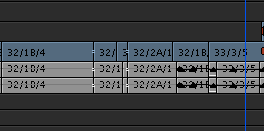
Now we’re ready to make the replacement. First check your patching. Everything should go straight across. You don’t want to be moving material from one track to another. Then simply hit extract (the scissors) and insert (the yellow edit button). The old material is deleted and the new material is inserted. This is what the timeline looks like after the insertion:

after extract and insert

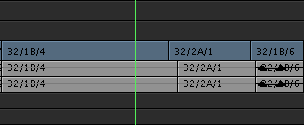
Note the unintentional splice marks. That’s the key. They prove that you did the replacement correctly, that the new material dropped in at the right place and the cut points matched up. If you don’t see those marks in every track, you’ve made a mistake. Undo twice, check your marks and try again.

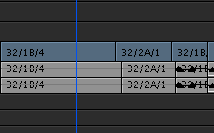
All that remains is to remove the unintentional splices. The easiest way is to lasso them and hit the delete key. Voila, your master version is up to date.

after throughs are removed

MC/FCP Differences

November 26, 2006

Several people have responded negatively to my suggestion that Final Cut Pro hews closer to a desktop publishing metaphor than Media Composer does. Admittedly, the differences are pretty subtle, but this issue was hotly debated in the early days and I, for one, advocated the idea that editors were more interested in moving pictures and how they look on a screen than on little rectangles and how you can move them around in a timeline. As much as possible, I wanted you to be able to make all editing decisions based on moving video. Avid’s engineers also did without an explicit toolbar and tried to make the cursor smart enough to do what you wanted when you wanted to do it.

In one sense the difference is just one of visual semantics. The MC has a ‘toolbar lite’ at the bottom of the timeline, where you choose effects, trim, segment or source/record mode. So you’re switching modes in both programs. But there are fewer modes in MC than there are tools in FCP, and to me, that makes it more intuitive. People who started working with one of the Adobe applications before learning to edit often find FCP more intuitive.

One question is whether this difference of approach leads to a different kind of editing, or is more appropriate for a different style, or with different kinds of material. One commentator suggested that FCP seems to be used more for documentaries and music videos and the MC more for features and television.

So how’s this for a hypothesis: FCP does a better job in segment mode than MC. It’s easier to drag things around, easier to rearrange clips, easier to create new and unexpected juxtapositions. MC is better in trim mode, better at tying material together, better at making disparate material look like continuous action. FCP is better for montages; MC is better for dialog. FCP is better at making cuts that jar you; MC is better at making cuts that are smooth as silk.

In addition, FCP is better in a standalone, home-brew environment, where you might be working with full-resolution media and doing your own visual effects, sound work or tech support. MC fits better in a world where teams of specialists have to collaborate and work with various kinds of media.

Wish List #2 – The Live Interface

November 11, 2006

What I find most frustrating about both the Media Composer and Final Cut these days is the static quality of the interface. We’re so used to this now that we don’t notice it, but if you play around with Apple’s Motion you might start to think differently. Even iTunes feels more live than our beloved picture editing programs.

What makes Motion different is that it’s designed to modify your animations while they continue to play. This may not sound like much but using it on a fast machine can feel liberating. You get instant feedback on whatever you are doing. There’s less waiting, less mousing around; you get a much clearer sense of connection to the material.

The Media Composer was born at a time when playing a sequence took all the horsepower the thing had. So it was designed around the idea that you’d press play, look at your work, press stop, change something, and then press play again. The Media Composer was so rigid in this regard that once you pressed play you couldn’t click the mouse anywhere without stopping video. That was how it was in 1991 and that’s how it is today, a decade and a half later.

Though it was designed more recently, Final Cut isn’t much better. But it does offer one huge advantage over the MC, namely the ability to scroll and zoom the timeline while video plays. Once you try that, you never want to go back.

That kind of dynamism, where nothing stops you, where you’re always making decisions based on moving images and sound and where you get live feedback on your changes, is the basis of the user interface of the future.

Here are some initial thoughts about what that might consist of. Some aren’t completely fleshed out — they’ll take some experimentation. But I hope they’ll be food for thought. Please contribute your suggestions.

  1. The timeline continues to play while you resize it.
  2. The timeline re-centers itself automatically when you play off either end.
  3. Windows can be resized or moved around while video continues to play.
  4. Rendering should happen in the background. In fact, whatever the machine is doing, it should do it in the background. You should never be stopped by the pinwheel cursor.
  5. Mixing moves, reverb, EQ, all should work while audio is playing. It should be possible to identify a portion of a sequence and play that material as a loop while you manipulate various effects.
  6. The same should be true for video effects. You should be able to apply and change them and see your changes while video plays. And you should be able to change parameters for transition effects while the transition plays as a loop.
  7. Finally, you should be able to independently play several video and audio sources at once. For example, it should be possible to gang the source and record monitors and play them simultaneously. It should be possible to audition music against picture by cueing the music in a popup monitor, playing your timeline and then hitting play in the pop-up. It should be possible to play dailies in the source monitor while you scroll around in the timeline or do other work.

The old paradigm was “make a change, press play.” The new paradigm is “press play, make a change.” A system that can do this is going to make our current machines seem quaint.

MC Speed

October 25, 2006

Right now I’m working with Xpress Pro (with Mojo) at work, and I’ve been playing with the new software-only Media Composer on a laptop at home. One thing I’m loving about MC software is how fast it puts frames on the screen.

One of my biggest gripes about Adrenaline has been how slow it felt when dragging through the timeline. Every frame hung on the screen for too long. You could drag through a reel and miss entire sequences. This is hard to explain in words, but it can make you feel like you’re dragging through molasses.

In the past, and to my surprise, I found Xpress faster than Adrenaline in this regard, but the comparison wasn’t totally fair since the Adrenaline system was connected to Unity and the Xpress machine wasn’t.

So far I’m finding that the new Media Composer, at least with local storage, is a real rocket ship in this regard. It feels so responsive when dragging that it’s actually sort of fun to just play with it.

In other respects, MC software feels pretty sluggish on the laptop: when scrubbing audio, opening big bins or working on long sequences with a lot of tracks. But I think it’ll work a lot better on a faster machine. I’m eager to see what it’s like with Unity.

Bottom line, I think there’s no longer any reason to hesitate about Adrenaline, and I’m talking about on the Mac. I would choose it every time, if for no other reason than that it lets you have 16 tracks of audio and does real-time audio dissolves. Get a fast machine with ample RAM. And consider using Mojo hardware rather than Adrenaline, or even software only. You may find that you like a lighter, simpler setup. I do.

Finally, don’t rule out Xpress. There are half a dozen things you’ll have to work around, but none were show stoppers for me. And it’s fast and stable on the Mac.