Archive for the ‘Avid’ category

Copy to Source Monitor

July 27, 2011

This won’t be new for some of you, but it’s a hidden feature and I use it so often that I thought I’d make mention of it.

Say you’re created a sound effect, or piece of music — anything you want to use again elsewhere. In other applications you’d Option-drag the clip in question, creating a copy at the destination of the drag. For some reason, Media Composer doesn’t support that standard operation. But it does offer you something that’s arguably more flexible: a quick shortcut to copy a selected clip or marked region to the source monitor. From there, you can edit it wherever you want. The shortcut, not visible in the menus, is Command-Option-C. Mark a region in the timeline and select tracks, or simply select a clip or clips. Then hit Command-Option-C. Your material instantly appears in the source monitor.

Note that if you copy selected clips they’ll appear with head and tail marks already assigned. That saves a couple of keystrokes. But if you marked a region instead, you’ll have to re-mark it in the source. Also note that if you select non-adjacent clips, MC will pad your selection with black, preserving their spatial relationship.

Here are two examples.

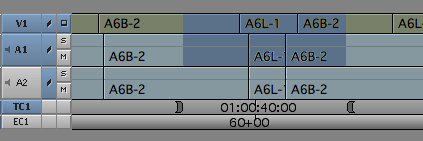
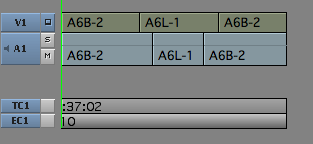
1. Copying clips.

Timeline before Command-Option-C:

Source Monitor after Command-Option-C:

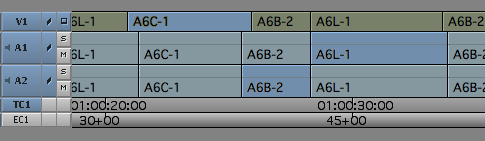
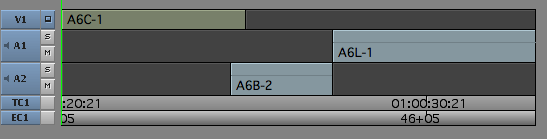
2. Copying a region.

Timeline before Command-Option-C:

Source Monitor after Command-Option-C:

Did Apple Know What They Were Doing?

July 26, 2011

For those of us fascinated by the evolution of editing technology, the Final Cut Pro X release is the gift that keeps on giving. Kanen Flowers has reinvigorated his long-dormant podcast, “That Post Show” (on iTunes), and the episode released yesterday covering FCP X a month after the launch, includes Mike J. Nichols, Paul del Vecchio, Peter Wells and Larry Jordan, talking about why the application is not for pros, at least not yet. But go to Apple’s FCP site and you’ll find the word “professional” everywhere, so much so that the whole thing seems defensive — a rarity  from Apple. The center of the page showcases four videos that highlight innovation in the program, again explicitly aimed at “professionals” and, shock of shocks, including screen grabs from the competition. Apple is feeling the heat, that’s for sure. They’ve damaged their biggest asset: the loyalty of their user base. Avid’s new management, by comparison, understands how precious that is (and current Media Composer users are a very loyal bunch).

The conventional wisdom right now seems to be that Jobs and Ubillos knew exactly what they were doing. They deliberately accepted the loss of the pro market in order to appeal to a much larger market. We may not like it, but it was a smart business decision — or so that line of reasoning goes. But I’m not so sure. Everybody makes mistakes, even Steve Jobs. Did the people at Apple really expect this much push-back? I’ve seen too many companies get stars in their eyes going after the Hollywood market to be confident that Apple is willing to write it off. I suspect that they want it all, and they still think we’ll come around. The question is whether the FCP X interface, which lacks a source monitor or bins, can ever be patched to work for people like me.

Apple has attempted to purify and clarify the editing model for a file-based era, removing anything that comes from film or linear tape. The source monitor — linear tape. Bins — film. EDLs — tape. Even in and out points are gone — again, they stem from the tape days. Frankly, I applaud that kind of out-of-the-box thinking. And there’s plenty of innovation in FCP X, innovation that I hope Avid and Adobe are busy copying. But Apple wins by taking chances, going where no one has gone before. And sometimes it goes to far. It sure seems like this is one of those times.

Let me end this post with a shameless plug. If you’re thinking about moving from Final Cut to Media Composer, you need my book, “Avid Agility.” MC is not a clone of FCP. Much of what makes it so powerful and responsive is hidden. The fastest way to understand why so many people think it’s the best way to edit is to get my book.

Dan Lebental talks to Debra Kaufman

July 18, 2011

Debra Kaufman, who recently became the associate editor at Creative Cow Magazine, has posted a terrific conversation with editor Dan Lebental, who just completed “Cowboys and Aliens.” Interviews with editors can sometimes be pretty dull, but this one is different. Check it out here.

Avid Event in Burbank

July 11, 2011

With an aim toward reminding everybody that Avid is fully committed to its high end customers, the company will host an event at the Burbank Studios this coming Wednesday night, July 13th. CEO Gary Greenfield and COO Kirk Arnold will be on hand to listen to editors’ concerns and answer questions, along with many members of the design teams for Media Composer and Pro Tools. It’s a good opportunity to share your thoughts and get a sense of where Avid is going. There will be demos of the latest versions of MC and PT, and refreshments will be served. Doors open at 6:30 at the Steven J. Ross Theater on the Warner’s Lot. Details are here. Be sure to register in advance, it’ll probably fill up.

Abandoning the Fans

July 10, 2011

In a recent Creative Cow podcast (on i-Tunes), Walter Biscardi and Richard Harrington go into vivid detail about why FCP-X won’t work for them as professional editors. Matthew Levie makes some similar points in a five-part diary describing his first experiences with the program. Though their comments represent the earliest of first impressions, the fact that these long-time FCP users had so many problems has to be taken seriously in Cupertino.

Whatever you think of Apple, Jobs and company sure have a knack for stirring things up. Depending on your background and your prejudices, Final Cut Pro X is either a stroke of genius, modernizing and expanding the company’s dominance in the semi-pro world, or a classic blunder, alienating some of its most loyal customers, who owe their careers to the democratization that FCP brought with it. The new program has many problems: no compatibility with FCP7, no import or export beyond Compressor and Motion, no provision for site or volume licensing, no good way to use multiple monitors, minimal support for tape I/O, a metaphor based on “events” and “projects” rather than media and sequences, a single on-screen viewer rather than the traditional source/record windows, and a powerful resemblance to iMovie. All of which says to existing professional users, “We don’t see you as our customers anymore.”

Apple is working a playbook it knows well, the same one it used with the original FCP: democratizing and enlarging the market by going after a group of customers that the other guy doesn’t know exists. But the first time, they were seen as a savior, a Pied Piper. This time, they have an existing user base. Those people have already pinned their hopes and built their businesses on Apple. All that accumulated experience now will have to be relearned.

This undoubtedly represents big opportunity for Avid and Adobe. But as pro users migrate to other applications, Apple’s competitors would do well to remember that FCP1 was also seen as a toy. Avid didn’t seem to take it seriously until the growing customer base began to suck the oxygen out of the post production environment. And despite the initial problems, FCP-X contains plenty of real innovation. At the end of the day, it’s the innovation that matters — the company that makes the best musical instrument, the one that lets me produce the sweetest music and have the most fun doing it, is the one I want to use.

As creative professionals, we all rely on an implicit, long-term collaboration with the developers of the applications we use. Did Apple made a business decision to accept defections at the top of the market in exchange for more customers further down the food chain? Or did its legendary secrecy cause it to underestimate the push-back it would encounter for changing so many basic features? It may take some time to sort that out. But one thing seems clear: the relationships we create with our favorite software applications may be more one-sided than we think.
Avid Reinstates FCP Cross-Grade

July 1, 2011

In the wake of Apple’s perceived abandonment of the professional editing community, and the desire of many FCP users to take fresh look at the competition, Avid will reinstate their Final Cut Pro “cross-grade” offer on July 5th, making it possible once again for licensed users of FCP (through version 7) to purchase a copy of Media Composer for $999, and find out why so many Media Composer editors would rather fight than switch. For details, see this message from Avid CEO Gary Greenfield. If you’re a student, you can take advantage of Avid’s academic pricing and get MC for $300, or you can download it for a 30-day free trial.

If you’re moving to Media Composer from Final Cut, I recommend that you take a look at my book Avid Agility. It’s your best way to get the most out of MC, and do it quickly. As one reviewer put it, it’s “the quickest path to becoming a Media Composer Jedi Master.” Check out additional reviews and sample pdfs here or order it from Amazon.