Local News — Not!

Posted March 18, 2010 by Steve
Categories: Media and Society

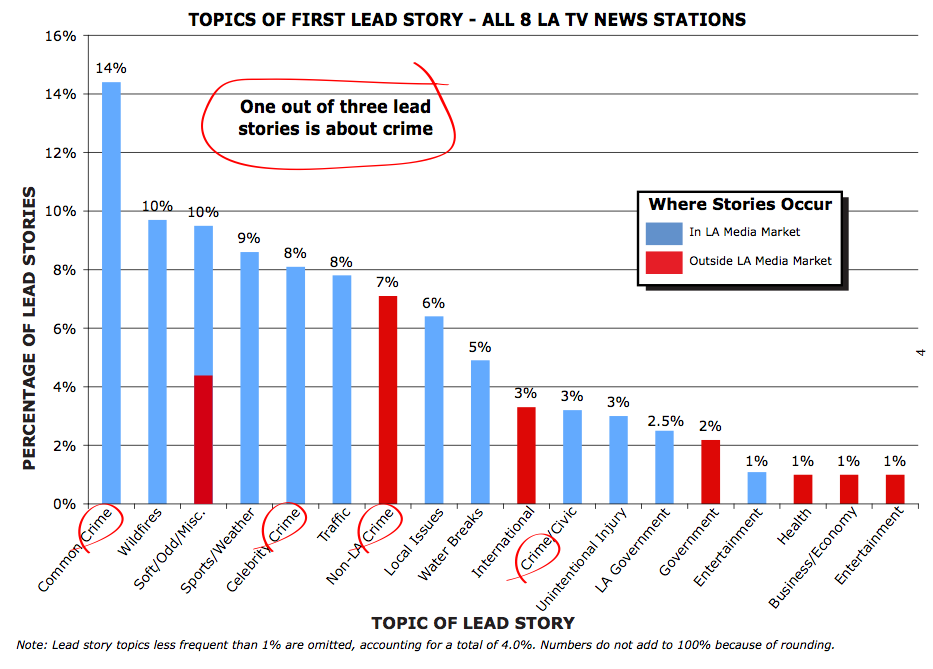
It probably won’t come as a surprise to you, but local news in Southern California is pretty much devoid of … well, news. Now, a recent study out of the Annenberg School of Communication at USC looks at 11,000 news stories and quantifies how devoid it is. Average nightly coverage of local government: 22 seconds in every 30 minutes. Yup. Twenty two seconds. Yet 68% of Americans say they get the majority of their news (whatever that is) from local TV.

Unlike the Internet, the airwaves are limited. Only a certain number of stations can broadcast, and they get licensed to do so by the federal government. That spectrum is worth big money, but the stations, once licensed, pay nothing. How hard is it to renew a license? You submit one postcard every eight years. Heck, it takes more effort to renew a driver’s license.

FCC Commissioner Michael Copps was interviewed on KPCC about this last week (listen to it here, or read his brief press release here). According to Copps, “twenty-seven states, over half of the states in this country, do not have an accredited reporter on Capitol Hill.” Wow. I’ve long been impressed by Copps. He’s a smart, unflappable public servant who does his homework and gets it.

Warren Olny interviewed Martin Kaplan, the co-author of the USC study, on his “Which Way LA?” radio show, yesterday. You can listen to the show here. (The interview begins at the half-way mark.) Olny offers some of the best local coverage around.

No citizen knowledge = no citizen involvement. And when nobody’s watching, mischief happens.

Conforming on the Desktop

Posted March 12, 2010 by Steve
Categories: Adobe Premiere, Avid, Workflow

NAB is only a few short weeks away, and I’ve heard very little about Adobe’s Mercury technology, slated for a “future release” of Premiere Pro. There’s a video demo and a blog page on the Adobe site (and a couple of other videos here and here), but no word of when the technology will make its appearance in a product you could buy.

I looked at the demo again the other day and despite its over-hyped style, it seems even more impressive the second time through. (My first post on the subject is here.) Will they release it at NAB, as part of Adobe CS5? If so, I think they’re going to make some waves. The demo shows the editing of 9 streams of P2 media —  each carrying a 3D effect. And it shows live multicam editing of 4K native red files. Yes — four streams of 4K Red (though it isn’t clear how much debayering they’re doing, which is critical). All this on a well-equipped PC with a $1400 video card (and what looks like 24 Gigs of RAM). As a little bonus, they demonstrate multi-stream playback of native AVCHD files and the ability to ingest and edit native digital SLR video.

I haven’t edited anything with Premiere. But from the demos I’ve seen the product is a study in contradictions. It can handle all kinds of files in their native state and can transcode and output to other formats in the background. It can directly import After Effects projects. It can do digital dialog transcription. But trimming is badly crippled. It has a cluttered interface that wastes too much space on video controllers and timecode displays. And it seems to have zero film support.

Of course, we won’t know how Mercury shapes up until after it’s released. But even if there are problems, it points toward a world where 4K editing and conforming will become commonplace. Whether we see it at NAB or not, it looks like 4K is coming soon to a desktop near you.

What’ll You Give Me for an Hour of Prime Time?

Posted March 10, 2010 by Steve
Categories: Media and Society

Somebody has finally done the math. The calculation is simple, but I’ve never seen it in print before. How much a network earns for an hour of primetime — per viewer. Take the total value of the ads run during that hour and divide by the total viewership.

Eduardo Porter has done this for an hour of “Desperate Housewives.” At the iTunes store, such an episode will set you back $2.99. But if you watch it, your attention is worth just 79 cents. Why the difference? Why do I pay more when I’m handing over cold hard cash than when I’m handing over access to my brain?

Read the article here: Television is Not Free and Does Not Want to Be.

One-Step Prelap

Posted March 8, 2010 by Steve
Categories: Avid Technical Tips, With Video

Overlap cuts (split edits) are fundamental for any editor. Most people create them in a two-step process, making a straight cut first and then overlapping it using Trim Mode. But there’s a hidden, one-step way to do it that you may find very intuitive. It only works at the end of your sequence, but that makes it very appropriate when you’re creating a first assembly and adding to the end of a growing sequence in the timeline. This short video (3:15) shows you how to do it. To view it at full size on Vimeo, click here.

Avid Receives ACE’s First-Ever Tech Award

Posted February 15, 2010 by Steve
Categories: Avid

The American Cinema Editors held its 60th annual Eddie awards ceremony last night with Bob Murawski & Chris Innis taking home the prize for “The Hurt Locker,” Debra Neil-Fisher winning for “The Hangover” and Kevin Nolting winning for “Up.” Alan Heim and Lee Percy won for “Grey Gardens.”

The ACE awards just seem to keep getting better, and this year the presentation was consistently entertaining, with a lot of humor and, at times, some rather edgy patter. I offer all the winners my humble congratulations.

From a tech-centric point of view, the highlight of the evening was ACE’s first-ever Technical Excellence Award, which went to the Media Composer. Avid CEO Gary Greenfield was there to receive it, and many Avid folk were on hand to share in the festivities.

The technical Eddie couldn’t have been awarded at a more appropriate time. Avid has made a remarkable turnaround in the last couple of years, and the Media Composer has come a long way very quickly. Congratulations to all those at Avid who helped make it possible.

The Winners Were:

Feature (Dramatic)
The Hurt Locker – Bob Murawski & Chris Innis

Feature (Comedy or Musical)
The Hangover – Debra Neil-Fisher, A.C.E.

Animated Feature
UP – Kevin Nolting

Half-Hour Series
30 Rock: “Apollo Apollo” – Ken Eluto, A.C.E.

One-Hour Series for Commercial TV
Breaking Bad: “ABQ” – Lynne Willingham, A.C.E.

One-Hour Series For Non-Commercial TV
Dexter: “Remains to be Seen” – Louis Cioffi

Miniseries or Motion Picture for TV
Grey Gardens – Alan Heim, A.C.E. & Lee Percy, A.C.E.

Documentary
The Cove – Geoffrey Richman

Reality Series
The Deadliest Catch: Stay Focused Or Die – Kelly Coskran & Josh Earl

Student Editing
Andrew Hellesen – Chapman University

Career Achievement
Neil Travis
Paul LaMastra

Golden Eddie
Rob Reiner

Technical Excellence
Avid Media Composer

Gigabit to the Home

Posted February 12, 2010 by Steve
Categories: Avid, Media and Society, Workflow

On Wednesday, Google announced plans to build a pilot project that will install high speed fiber-to-the-home in select locations. They’re projecting gigabit speeds for this network and are planning to open it up, meaning that they’ll lease it to many service providers. I once participated in a workshop that demonstrated the use of cable TV wiring to bring digital information to the home. This was several years before I’d ever seen a browser, let alone a cable modem. The inventors thought they could provide a gigabit of speed, and to them, a gigabit was the holy grail, the speed at which everything changed. Today at 5 megabits, we’re getting less than 1% of that.

Google has only proposed a pilot project and it may be a while before anybody actually uses it. Still, the idea is tantalyzing, and, given enough time, inevitable. The major fiber-to-the-home scheme available now is Verizon’s FIOS. It offers 15-50 megabits.

Imagine that your connectivity is 100 times faster than it is now. And that you could buy it from multiple providers. That’s going to change digital editing in fundamental ways, making real-time remote collaboration possible and forcing editors to compete with each other worldwide. What would you do with speeds like that?

For more, see the Google Fiber for Communities page, or this article at Ars Technica. Use this link to nominate your community for the test.