Hilary declared her intention to run for president on Saturday, and a lead article in Sunday’s New York Times focused on the fact that Hilary and Obama are each attempting to raise about $75 million — this year alone. An article in today’s paper goes further, telling us that Hilary has decided to skip public financing altogether, thus raising the ante further. Michael E. Toner, chairman of the Federal Election Commission, put it this way, “We are looking at a $100 million entry fee.”
Running for office doesn’t really mean connecting with your constituents, fashioning brilliant policy and building a consensus for it. It means fundraising: creating a war chest that will primarily be used to buy our favorite commodity — television airtime. Hilary’s big advantage is her history in Washington and her access to the Democratic Party fundraising machine.
So here are a few statistics to ponder, picked up from the National Conference for Media Reform:
- The 2006 election, where no presidential contest was involved, cost $3 billion nationwide. $2 billion was spent on TV and radio ads.
- Much of that money went to a few large media companies who consistently resist public financing for elections.
- 65% of the American public says that their primary news source is local TV news.
- Local TV carries almost no election coverage, and when it does, almost no policy information.
- The primary source of information about candidates in America comes from 30-second spots, which, almost by necessity, offer distorted information.
Now I ask you — is this the best way we can figure out to select our leadership?
 The New York Times ran its second
  WordPress, the service I’m using for this blog, has added a new feature called “Snap.” When you hover over a link a little window opens showing a preview of the linked page. It threw me at first, but after fooling around with it for a few minutes I think it might be pretty cool. If you don’t like it, you can turn it off via the options button at the top right of a Snap window.
 Bill Moyers gave a terrific, passionate and eloquent speech at the
 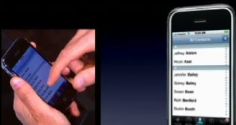 I’ve now watched Steve Jobs’ Macworld keynote and have to admit that I’ve got a little bit of egg on my face. Those of you who’ve seen it will note that Steve tied together his big three product innovations, the original Mac, the iPod and now the iPhone, and explicitly talked about how each was based on a revolutionary input device: the mouse, the touch-wheel and now the multi-touch screen. This was my point in the previous post, but of course, at that point, I hadn’t seen the speech.


 Splice Now
Recent Comments