Phil Hodgetts and Terry Curren devote their latest podcast (website — itunes) to speculation about the upcoming Final Cut Pro 8, and what might have transpired at the super-secret demo that Apple held for 100 luminaries on Feb 17. The main takeaway: no viewer/source monitor (as in iTunes), no tape I/O, background rendering, all 64-bit, running on a new modern codebase that is no longer tied to Quicktime — and all purely speculative, of course. But it makes for interesting listening. The release is promised this Spring.
Archive for the ‘Avid vs. Final Cut’ category
FCP Speculation
March 5, 2011Pre-NAB Editors Lounge
March 1, 2011Later this month I’ll be participating in the what I hope will be an insightful and provocative Pre-NAB Editors Lounge Panel Discussion, hosted by Terry Curren and his company AlphaDogs in partnership with Key Code Media. The Editors Lounge is a great place to meet other editors, get questions answered, and generally stay current. And the food ain’t bad, either. This event will also feature a demo of Sony’s new OLED production monitor (list price, just $26,000).
Panelists: Debra Kaufman, Lucas Wilson, Mark Raudonis, Michael Bravin, Terry Curren and me.
Date and Time: Friday, 3/25 at 6:15 pm
Location: Key Code Media, 270 S. Flower St, Burbank, CA 91502
Final Cut Pro Rumors
February 23, 2011We haven’t seen a new version of Final Cut Pro in over two years, and with Apple hiring new UI engineers not so long ago, rumors of a new version have cropped up repeatedly. Apple apparently showed off the new version recently and impressed some people. Mac Rumors breaks the news, here. And Larry Jordan mentions in on his blog, here. Nothing specific — just enough to whet your appetite, in classic Apple fashion. Steve Jobs’ competitive strategy has always been based on the idea that Apple has to aggressively lead, breaking old rules and creating new paradigms. Will this FCP do that? What would a new user interface look like? Will it offer a new interaction model to replace the old play-stop-adjust-play-stop-adjust cycle we’re all so used to? Multi-touch? Will it use modern CPUs and GPUs to speed things up the way Premiere does? And most important for those of us in the trenches — will it interface with current technology or force changes throughout the pipeline? Looks like we’ll be finding out soon.
Interview on Hollywood Reinvented
November 13, 2010My friend Larry Jordan, editor and creator of the new blog Hollywood Reinvented, has just posted an extended video interview with me. Topics covered include digital editing in general, Final Cut vs. Media Composer, the need for editors, and the future of post production. It’s all nicely edited into tasty, bite-sized pieces (if you let it play, it’ll move from clip to clip without interruption). The full post is here. I hope you enjoy it.
Conforming Red
October 17, 2010 Red is now Hollywood’s great science experiment, with workflow options proliferating almost every day. How do you do dailies? How do you transcode and sync? Who is archiving your media? We’re finally starting to get our arms around those issues, but there are still too many options. And the bigger question now is how you conform.
“The Social Network” team actually did it in their offline cutting room, moving from Final Cut to Premiere and from there to After Effects, using EDLs (not XMLs) and dpx files (not the native R3D files). They then turned over to a Pablo for timing. (Adobe has posted a video laying this out.) I’m finishing a TV movie that was cut with Media Composer 5, conformed in Smoke and timed in Lustre using the native R3Ds, which gave us all kinds of color control. And those are just two of the dozens of permutations available. Before we started shooting, I spent a full week going over them, and at the end, the conversations were so filled with jargon that a normal mortal listening in would have thought we were nuts.
We do more and more visual effects work in our offline editing rooms. In television, I’ve gotten very spoiled seeing my work conformed perfectly using Symphony. There’s a tremendous sense of freedom in that — if you get something right, it’s finished and you never need to think about it again. But in features we don’t generally experience that particular thrill, because above HD resolution everything has to be rebuilt, and too often, by eye. Each system has its strengths and weaknesses. Smoke is powerful, interfaces with Lustre for timing and understands many MC4 effects — but MC5 is another story. Baselight understands XML (but not all effects). After Effects is cheap but doesn’t understand either one. And that’s just the tip of the iceberg.
The whole thing is a mess. Conforming complex visual effects by eye is crazy, and somebody is going to make real money straightening it all out. More fundamentally, will we be conforming in our cutting rooms or at a post house? Or will increases in processing power make the whole thing moot?
Meanwhile, be prepared for a new workflow on every show you do, with new options, new gotchas, and new things to learn each time.
MC5 Rides Again
June 2, 2010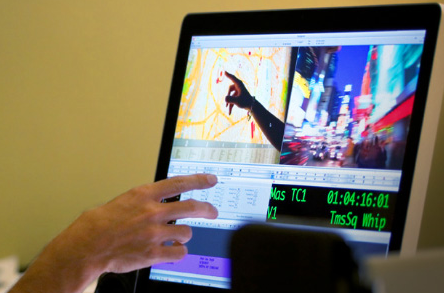 Media Composer 5 will be released a week from tomorrow, and without question, it represents the biggest upgrade Avid has offered in years — since the last version 5, to be exact, way back in 1994, when the modern Media Composer was born. The symmetry is the result of Avid resetting its numbering scheme in 2003. So here we are at version 5 again. Five was — and is — a very good number for Avid. I can still remember the cheering at the user group meetings. I wouldn’t be surprised if we see that same excitement this time.
This version brings timeline changes that should appeal to the Final Cut Pro crowd and that arguably go FCP one better, making it easy to grab-and-drag in the timeline without monkeying with a tool palette. That’s because Avid’s new tools are smart, and let you select a segment or a transition or a keyframe without a trip to the toolbar. You can also stay in what used to be called Segment Mode and move around without losing clip selection.
Other changes include realtime audio effects, stereo tracks and clips, advanced keyframes for most visual effects and automatic image stabilization. And, of course, Quicktime AMA, which means that you no longer have to import and transcode Quicktime materials. Not every format is equally responsive, but with the right codec and the right hardware you won’t need to import. Red (R3D) material is handled natively, too, along with Canon DSLR material.
Meanwhile, Avid has blessed a Matrox box as a low cost monitoring solution, and announced a software developer kit for other hardware manufacturers, which means that one of these days there will probably be a choice of non-native hardware offerings for Avid folk.
And, of course, there’s the student price of just $300 for the full version, with four years of free upgrades. And a 30-day downloadable free trial for everybody else.
All in all, this is an exciting time for Avid. I’ve been beta testing the new version and working full time on a new Media Composer book, titled Avid Agility. With luck, it’ll be available on Amazon by mid-July. I hope you’ll find it essential reading.
Meanwhile, I’ll be demoing MC5 at the LA Final Cut Pro User Group, on Wednesday, June 16 at Barnsdall Park.
It’s only the 2nd of June, and already it’s shaping up as a very interesting month.


 Splice Now
Recent Comments