Avid Names a New CEO

Posted December 20, 2007 by Steve
Categories: Avid

In a much anticipated development, Avid announced the hiring of Gary Greenfield as CEO and chairman of the board. He’ll replace Nancy Hawthorne, who served as temporary CEO while a permanent replacement for David Krall was found. Hawthorne will assume the role of lead director on the board. Avid’s press release included the following quotes:

Hawthorne: “We sought a leader who had direct experience in helping complex and multi-dimensional public companies achieve their goals. Gary is an outstanding choice to lead the company into a new era of growth.”

Greenfield: “Avid has a rich 20-year history as a vibrant and innovative technology pioneer, whose family of brands stands at the forefront of technology for the digital media and entertainment industries — that’s what made the opportunity to join the company so attractive. I believe Avid can become a true media powerhouse and I am excited to lead that charge.”

Greenfield formerly led a company called GXS, a “provider of business-to-business integration, synchronization and collaboration solutions.” You can listen to the company’s conference call introducing Greenfield here. (I couldn’t make it work on a Mac. Maybe you’ll have better luck on a PC.)

Technorati Tags: ,

Clip Color

Posted December 18, 2007 by Steve
Categories: Avid Technical Tips

I’m sure this will be obvious to some of you, but I’ve found that many people don’t use Avid’s powerful ability to colorize clips in the timeline. It’s not always intuitive, but once set up, this can be very helpful in finding things visually.

You can colorize clips in no less than four ways:

  1. The timeline can show you all offline material in red. This can be very helpful if you want to do a quick check before making a digital cut.
  2. You can change the color of an individual clip anywhere in the timeline. Useful to tag something so you can easily find it again.
  3. You can have the MC show you every instance of a particular source clip in a specific color. This offers a quick answer to “Where did I use this shot?” or “How many times did I use this shot?”
  4. You can have the MC distinguish clips based on their resolution or whether they are standard def or high def.

Each feature is invoked in a slightly different way — and therein lies the confusion.

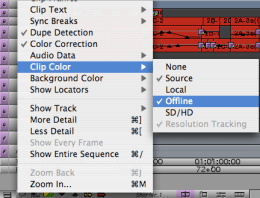
1. To invoke “offline” clip coloring, simply select that option in the timeline popup menu.

offline-color.png

Now, every offline clip will be displayed in red.

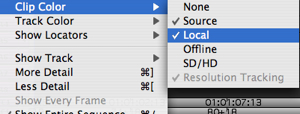
2. To colorize a specific shot — Avid calls this “local” color — several steps are needed. First, make sure that local color is turned on by selecting that option in the timeline popup.

Turn On Local Color In Tl

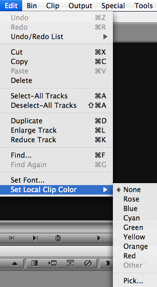
Then select the clip you’re interested in using segment mode, and change it’s color via the Edit menu:

Set Local Clip Color

The shot you selected via segment mode will change color.

3. To colorize every instance of a particular source clip, first turn that feature on in the timeline by selecting Clip Color > Source. Then go to the bin that contains the clip and activate the “color” bin column.

Turn On Clip Color In Bin

Finally, put your cursor into the “color” bin column. A popup menu will appear and you can select a color for that source clip. Every time you use that shot in a sequence it’ll be shown in the color you choose.

4. To have the timeline colorize SD and HD clips, select that option from the timeline popup. For more about resolution coloring (using Avid’s “MultiRez” feature) see your manual.

Technorati Tags: , , ,

Useful Comparison of Avid and Final Cut

Posted December 12, 2007 by Steve
Categories: Avid vs. Final Cut

Loren Miller has posted a detailed and thoughtful analysis of the differences and similarities between Media Composer and Final Cut. It’s aimed at people who are already familiar with Media Composer and are learning FCP:

The Changeover Challenge: From Avid to Final Cut Pro

It’s on the Avid to Final Cut Pro site, which offers many useful tips for people moving from MC to FCP. It includes a forum where you can post questions and a blog, as well.

Thanks to Martin Baker, Jude Cotter, Victoria Parks-Murphy, Mark Raudonis and Shane Ross for putting this valuable site together.

Technorati Tags: , , , ,

Totally Portable – Not!

Posted December 9, 2007 by Steve
Categories: Avid, Avid Technical Tips, Laptop Editing, Workflow

I’m about to start a mix and I thought that it would be nice to have my whole show available on a laptop while we worked. This can be helpful in a pinch, and I figured it would be easy to arrange. Four hours of frustration later, I’m not so sure.

We have about 7,000 OMF media files taking up about 200 gigs of space and living on six Unity partitions. Each partition has a separate media folder, and each one contains two “msm” files, which constitute an index of what’s on the drive. The MC needs those files, and if they’re not there, it will create them.

My task was to move all that of our media into a single folder on a firewire drive and open that up with the laptop system. The folder would be re-indexed and all would be well.

Trouble is, MC-software won’t index that media folder. Roughly half way through the initial scan it consistently crashes. That seemed awfully strange to me, so I tried using our main Adrenaline machine to create the index (taking Unity offline, connecting the firewire drive and starting up the MC). That worked fine. So I figured I had a good index and could now open the firewire drive on the laptop. Nope — even with a good index, the laptop wants to scan the drive — and crashes halfway through.

There are differences between the desktop and laptop systems: one is a quad-G5 tower with four gigs of RAM, the other, and core duo Mac Pro with 2 gigs. I’ve never known one to be allergic to drives indexed with the other, but you never know.

So I created a much smaller media files folder with just a couple of hundred clips — the laptop was able to index that just fine. And I was able to add media files to that folder successfully — but only until I got to around 3,000 files, at which point the laptop would crash halfway through the scan — leaving behind a corrupted index.

After four hours trying all of the above and everything else I and our rental house could think of, I gave up.

Maybe a system with 2 gigs of RAM can’t read a big index. Maybe an Intel system can’t read a big index. Maybe an Intel system can’t read an index created on a G5. But one way or the other, I can’t take my show on the road.

Technorati Tags: , ,

Let Them Eat Reruns

Posted November 20, 2007 by Steve
Categories: Editors Guild, Media and Society

With the WGA and AMPTP now slated to resume negotiations after the Thanksgiving holiday there may be a ray of hope for the resumption of production.

The producers had said they’d never sit down again while a strike was proceeding, and now it seems that this was just negotiating bluster. Needless to say, both sides try to sound as tough as they can during this process — that’s what negotiations are all about.

In this vein, the producers have floated the idea that the strike will turn out to be a net positive for them. They’ll just air reruns or new reality shows and, after the strike hits its sixth week, they’ll be able to use “force majeure” clauses to break various development and production deals that they’ve wanted out of.

But here’s the rub — are audiences really that stupid? Do they really not notice the difference between reruns and original programming? Do new reality shows have a guaranteed audience? Frankly, I doubt it.

To see it otherwise is to assume that it doesn’t matter what’s on the air — the suckers in the audience are going to watch anyway. That breaks the oldest rule in the book: “Never underestimate your audience.” TV may be addictive, but there are plenty of other screens available now and when the public gets bored, they’re going to go elsewhere.

Hopefully, cooler heads are going to prevail, and the parties will find a way to share the wealth. Unlike most of the news coverage so far, an article in today’s NY Times offers some specifics about the deal points in question using webisodes of “Lost” as an example.

Technorati Tags:

Avid’s Consumer Strategy

Posted November 18, 2007 by Steve
Categories: Avid, Avid vs. Final Cut, Consumer Editing

Nancy Hawthorne, Avid’s new interim CEO, spoke to stock analysts at the JP Morgan Small/Mid Cap Conference in Boston a couple of weeks ago and said some interesting and important things. The company “did not integrate the several acquisitions that we did particularly well, and as a result, we have kind of a mishmash of different systems, and the company has not been positioned strategically to operate as a seamless entity in presenting a lineup of products to the marketplace.”

That’s certainly true and it’s great to hear a high-level Avid executive say so. She also talked about the company’s new focus on product quality, again a very positive thing.

She stressed the company’s expertise with big enterprise customers, and, regarding the Pinnacle division, commented, “we do need to understand what role the lower-end technology plays in our lineup. Is it strategically critical to us, or is it not?”

A week later Apple dropped the price of Final Cut Express from $300 to $200, added a mixed HD/SD timeline, and improved compatibility with iMovie.

All of which begs a key question: can Avid make a business at the top of the professional market and avoid direct competition with Apple, or is there really only one, increasingly democratized market that everybody is part of, one way or another? To put it another way, can you envision a future where young people use iMovie and FC Express and then come to Hollywood and switch to Media Composer?

Maybe — but for that to work, Avid would have to be innovating like mad in the professional world, with a product that was clearly and unambiguously superior. If FCP and MC are even roughly competitive, then it seems to me that you have to go after mindshare — which means you gotta get ’em young. Apple hasn’t won this game yet — iMovie ’08 got a decidedly mixed reception when it was introduced, and there’s a huge paradigm shift between iMovie and Final Cut. Avid, coming later to the party, could build something more consistent and scalable.

But either way, whether Avid wants to go after the whole shebang or just the professional market, they’ve gotta get busy with the software, making it sing for the people who use it, namely editors.

My intuition is that there’s only one game in town. Focusing on the pro market can only succeed as a temporary strategy. In the end, you’ve gotta duke it out at all levels. Otherwise the pressure from below will kill you.

Technorati Tags: , ,