Preloaded Production

Posted August 28, 2007 by Steve
Categories: Labor, Media and Society

The LA Times ran a big article this Sunday about how the studios, in a re-enactment of what happened in 2001, are ramping up production now, so they’ll have as many pictures as possible in the can when the SAG contract expires next summer. (The WGA contract ends in October but will be extended to line up with SAG’s.)

Why? Well, the article never answers that question. Instead, it seems to imply that it’s so self evident that studios would want to get as much material shot as possible before a strike, that the most basic question of all need not be asked.

Maybe it’s obvious, but to me the huge elephant in the room does bear mentioning, namely that producers are trying to get stuff in the can because it gives them an advantage in contract talks. If I’ve got a slate of pictures shot, you can strike for as long as you want dear actors and writers — it won’t affect me at all. So preloading production is essentially a negotiating tactic, a way to work the system for your advantage, and get what you want at the negotiating table. It’s not illegal, and it’s certainly not surprising, but it bears mentioning in an article that brags about how it’s based on “two dozen” interviews with producers and agents — and apparently with zero labor leaders.

Technorati Tags:

Avid on “Entourage”

Posted August 28, 2007 by Steve
Categories: Avid

Anybody catch “Entourage” Sunday night on HBO? One scene takes place in Sidney Pollack’s editing room. I was carefully scrutinizing the editing system’s screens trying to figure out if they were using FCP or MC, when I realized that the bin window had been dragged halfway off the screen — revealing a huge Avid logo. Product placement doesn’t get a lot more plain than that.

Technorati Tags:

Throw Out the Old

Posted August 27, 2007 by Steve
Categories: Consumer Editing, User Interface, Workflow

The debate over iMovie ’08 continues — with many people expressing disappointment over the loss of timeline, visual effects and sound functions. I haven’t used it and I’m not sure if I ever will. But I love the idea of it. Why? Three reasons:

First, it embodies a clear and uncompromising point of view about what the “end user” really wants. And it fearlessly throws away old ideas to get there.

Second, it comes from the mind of one person. According to Apple, it was initially developed by one engineer, who, frustrated with current tools, including iMovie, created something else, at first just for himself. Groups rarely design great software. People do.

Third, it includes new user interface elements (skimming) that increase human/machine bandwidth. You feel a connection to the software because it does a better job of connecting to your nervous system. Think of the mouse, the iPod’s scroll wheel, or the iPhone’s multi-touch screen. They all connect you to the machine much more closely than what came before. You have a greater sense of control, and you enjoy using the machine more.

Frankly, I’m also unmoved by all this nostalgia for the old iMovie. The notion that it allowed for precise editing is silly. It was impossible to trim a cut carefully or do all kinds of things professionals expect. And it was slow. The idea that there wasn’t a better way was never credible to me.

Finally, the new iMovie is designed to shine in all-digital work environments, which frankly, is where the consumer (and everybody else) is going, sooner rather than later. I’d be very surprised if any home user is shooting on tape five years from now.

Apple now has a new platform. And they’ll add all kinds of features as time goes by. Creative destruction is what new things are made of.

Technorati Tags:

Settings Galore

Posted August 22, 2007 by Steve
Categories: Avid Technical Tips

The Media Composer just keeps getting more flexible and powerful. But with all this flexibility comes complexity. And good as Avid is at making the machine do whatever we might desire, it often fails when the time comes to explain those capabilities. Without the explanation, the power isn’t worth all that much.

I’m starting  new show with Adrenaline machines, using the latest software, Quad-core G5s and Unity. First impressions — very fast. Probably the most responsive Avid I’ve ever used. And a far cry from the early, and very buggy, Adrenaline machines I’ve used in the past.

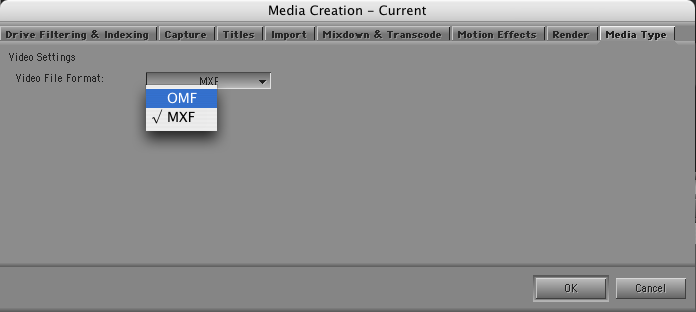
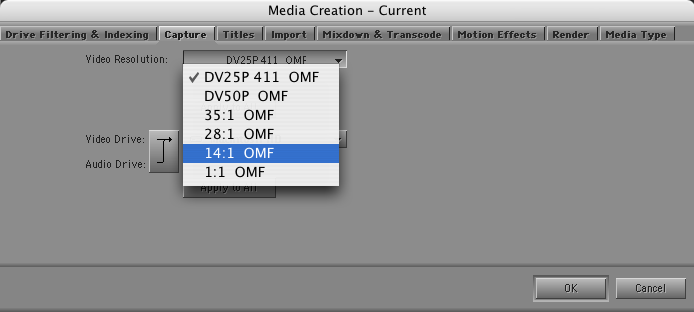
But there sure are a lot of settings to pay attention to. Many are hidden. Most are unexplained. Here’s a basic example: Media Creation. When you digitize you can now create MXF or OMF files. MXF is the default. Want to make OMFs? You need to do a little searching. Turns out the choice is in the Media Creation setting pane — in two places. First use the last tab to select your “Media Type.” Then select your actual resolution in the Capture tab. And if you want to create AIFF audio files instead of WAV, you’ll need to locate another setting: “Audio Project.”

Media Creation Settings 1

Media Creation Settings 2

Audio Media Setting

Then there are the “Film and 24P” settings. I can guess what they mean, but it sure would be useful to actually know what they mean. The help system tells us little more than to select the settings you want.

Defaults and settings have been a bugaboo of the Media Composer since the early days. They’ve been responsible for a lot of problems. If you set up your project incorrectly you pay for it later.

Avid needs to add some explanatory text to these settings panes — text that is vetted by real editors to make sure it conveys the meaning intended. A little money invested here might save a lot of money on customer support.

Technorati Tags: , , ,

Creating a News Narrative from the Debate

Posted August 21, 2007 by Steve
Categories: Media and Society

Judging from a promo for “Hard Ball” that I caught while grabbing a cup of coffee yesterday, the pundits are doing their best to amplify the irrelevant pseudo-disagreements that Mr. Stephanopolous tried so hard to create in yesterday’s debate and turn it into “must-see TV.” A huge “controversy” was what the Matthews show was hyping — something that bore almost no resemblance to the debate itself, let alone to any kind of substance.

And of course, since nobody actually saw the debate, nobody can say whether the little snippets that will be pounded on are representative. This gives the punditry and the networks much greater power to create a narrative — a narrative that has very little to do with reality.

When two kids in my junior high schoolyard would argue or play the dozens, a crowd would often form and try to get them to fight. They’d call out “you take that from him?!” and egg the parties on. Somehow it feels very old and pre-verbal — the tribe needs to establish the alpha-dog. So I suppose there’s nothing new about Stephanopoulis’ approach, as long as you assume that we haven’t evolved much in the last 10,000 years or so.

The Stealth Debates

Posted August 20, 2007 by Steve
Categories: Media and Society

What’s up with these presidential debates, anyway? The stealth debates, I should say, because it seems like nobody really wants us to see them. Did you know beforehand that there was a Democratic debate yesterday? It ran on ABC at 8 AM Pacific Time. George Stepanopoulis was the moderator and he worked overtime trying to make the candidates attack each other and focus on the kind of phony polarizing irrelevancies that TV news media seems to love so much. After the freshness of the questions on the You Tube/CNN debate it seemed even more irrelevant than ever.

Personally, I think there are some really hard problems we need to solve pronto. For example: extricating ourselves from Iraq without creating a blood bath, effectively dealing with global warming, and providing affordable health care for everybody. None of these things are going to be easy and these debates could be a good way to bring some of the difficult policy questions before the American people.

All the debates have been giving extra time to the three “front runners.” I put front runner in quotes because it just so happens that these are the folks with the big money and they’re going to be giving a lot of it to the networks. They’re ahead primarily because they’ve got good fund raising operations and thus, if you’re cynical, you might wonder whether they’re already bought and paid for.

We are well over a year away from election day. I want to hear from all the candidates. Biden, Dodd, Kucinich, Richardson and yes, even Gravel are the ones with the new ideas. They have less to lose and they sound a lot less scripted. Let’s hear from them. Maybe they’ll make the front runners work a little harder and talk a little more specifically.

The reason I bring this up is that there’s a media policy question at stake and it goes like this: The airwaves are a public resource. The networks license them and are supposed to use them not just to make a profit but for the public good. In the case of the HD spectrum the networks got all that extra bandwidth for free. We asked for nothing in return. Right now it seems like the absolute minimum we ought to get are debates that are widely publicized, that run at reasonable times of the day on broadcast television (not just cable), that give all candidates equal time, and that are archived on the web so anybody can see them at any time. It seems to me that, in a democracy, we should expect nothing less.

Technorati Tags: